Anwar al-Awlaki: The Jim Jones of Islam

May 23rd, 2010

As a Muslim and as an American, let me say this loudly and clearly — Anwar al-Awlaki is a servant of evil and a traitor both to Islam and to America. He is intent on misleading the world by spreading the lie that Islam permits the killing of civilians. It does not.

Prophet Muhammad forbade the killing of non-combatants and reacted with horror when he heard of civilian deaths on the battlefield. In order to expound his own political agenda, Al-Awlaki is defaming the Prophet and the global Muslim community, which rejects terrorism. And in the process, he is revealing himself to be a modern Jim Jones – a narcissist creating a death cult.

In 1978, Jim Jones led 900 of his devoted followers to mass suicide by forcing them to drink cyanide mixed in a fruit beverage. The term “drinking the Kool-Aid” has since become synonymous with people who blindly follow their leaders to their doom. And it is clear that al-Awlaki’s followers are very much drinking his brand of Kool-Aid. Indeed, the alleged Fort Hood shooter, Major Nidal Malik Hasan, was apparently a follower of al-Awlaki before he turned on his fellow soldiers in an orgy of murder. Like Jim Jones, al-Awlaki has remarkable charisma and uses it to lead his followers down a very dark path.

I say all of this with great grief. Al-Awlaki was once a highly regarded Muslim scholar who taught a message of peace and brotherhood. But his story is like that of the archetypal villain of the movie Star Wars – Anakin Skywalker, a defender of justice, who devolves into Darth Vader, a monster who cares only for his own twisted quest for power.

I have never met al-Awlaki, but those who have tell me that in his early days as a preacher, he espoused a moderate Islam based on scholarship and appreciation for Muslim history. Yet after the terrorist attack of September 11, 2001, and the subsequent wars in Afghanistan and Iraq, al-Alwaki began to change. He began to see the world in a binary “us versus them” outlook – the hallmark of fundamentalism. After being detained by the Yemeni government in 2006 (apparently under American pressure), he appears to have left his moderate past behind him and embraced a dark vision of Islam at perpetual war with America – and became its most passionate scholarly advocate.

Al-Awlaki’s story could be dismissed as the sad tale of a good man who became lost. And yet his personal moral decline has greater consequences. For he built up a widespread and devoted following among Muslims in his heyday – and is now in a position to brainwash many of his followers into following his own descent into darkness.

When I have publicly criticized al-Awlaki, I have received emails from his devotees saying that he is being “set up” by the US government. And yet when I ask them what they mean by this, there is always pin-drop silence. His followers seem to want to believe that the good, charismatic man that they adore is somehow being falsely portrayed in the media as a villain as part of some “Psy Ops” manipulation game. And yet when I ask if someone else is posting his increasingly radical and extremist sermons through his website (a CIA agent posing as al-Awlaki, let’s say), there is more silence. It is as if his followers want to keep clinging to the man he once was and selectively ignore his recent calls for the murder of civilians in the name of Islam.

Like Jim Jones, a personality cult has formed around al-Awlaki. It is a personality cult that is blinding his followers into a series of non-sequiturs and conspiracy theories that allow them to overcome the cognitive dissonance of reconciling the good scholar they once knew and the deranged and hateful man he has become.

There is a word for that kind of personality cult in Islam – idolatry. If there are any Muslims out there that believe that a man should be followed unquestioningly, even when his words violate basic Islamic teachings, then they have committed shirk, the worst sin in Islam – ascribing a partner to God. They have given their devotion to a false god, a fallible human being rather the infallible Creator, the Merciful and Compassionate, the Lord of the Worlds, whose moral commandments cannot be rationalized away by men.

I was sickened and outraged by al-Awlaki’s recent video, where he rationalized terrorist plots to blow up airplanes, saying that the deaths of civilians are just “a drop of water in the sea.” Similar rationalizations were used by pre-Islamic Arabs who practiced female infanticide, burying their newborn baby daughters alive. Such innocent lives were also simply “drops in the sea” for a pagan culture obsessed with male progeny. But when the Holy Qur’an put an end to this barbarism, it said that on the Day of Judgment, the innocent girls will rise from their graves and confront their murderers, and God will ask: “For what crime was she killed?” (Surah 81:8-9) And then the murderers’ excuses will vanish and they will be flung into Hell.

The God of the Qur’an is the God of life, of mercy, of justice. A God that says “no soul shall bear the burden of another” (53:38) when confronted with moral relativists that believe in “guilt by association” and collective punishment.

If Muslims wish to find a true example in their history of a noble warrior, they should turn away from this false teacher al-Awlaki and look at the example of Saladin, the great Muslim leader who conquered Jerusalem in 1187 C.E.

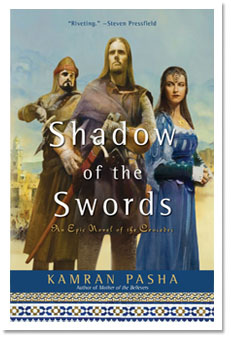
In my new novel, Shadow of the Swords, I show how, despite calls for collective punishment against the Christians of Jerusalem for the crimes of the Crusaders, Saladin showed mercy to the populace. He let the Christian population remain unmolested and gave them freedom of worship and pilgrimage to their holy sites. When Richard the Lion Heart led the Third Crusade to expel the Muslims, Saladin treated his enemy with stunning generosity. When Richard fell ill, Saladin sent his personal doctor to tend to the enemy king. When Richard’s horse was killed in battle, Saladin sent his personal horse to his adversary as a gift.

Saladin’s acts of honor and wisdom single-handedly shattered the negative image that many Christians held of Muslims. And for this, he is lauded by both Christian and Muslim historians as a true statesman and moral leader.

I ask any follower of al-Awlaki – which is the greater example you wish to be associated with? The example of your “teacher” who calls you to turn into monsters without empathy? Or Saladin, who reminded the world that Islam stood for justice and moral restraint, not barbarism and rationalization of murder? If you have any hesitation about the right answer here, then you have left your religion and become the very evil that anti-Muslim bigots have long claimed Islam represents.

The confusion al-Awlaki has created among Muslims is in many ways far more insidious than that of his fellow madman, Osama Bin Laden. For Bin Laden does not claim to be – and is not – an Islamic scholar. Bin Laden’s calls for attacking the West are not steeped in Islamic scholarship, but in a rather crude “eye for an eye” philosophy that says since Americans are killing Muslim civilians, Muslims have a right do the same in return to American civilians. Bin Laden has little understanding of, or interest in, Islamic jurisprudence, primarily because he finds its rules against murdering civilians to be inconvenient. Therefore Bin Laden’s appeal is really based on an emotional bait-and-switch. Get Muslims riled up about all the injustices they have experienced so that they follow him – and not ask too many questions about the justice of his own movement.

But al-Awlaki’s brand of evil is far more sinister. As a trained Muslim scholar, he is an expert in perverting traditional Islamic teachings with strange analogies that have no historical basis, such as his self-serving argument that Americans elected and pay taxes to a government that kills Muslims, so all Americans are complicit and are lawful targets of revenge. Aside from the fact that this is a nonsensical leap of logic, it ignores what Prophet Muhammad himself did when faced with the opportunity for collectively punishing a population for the crime of its leaders.

In my novel Mother of the Believers, I discuss how, when the Prophet defeated Mecca, he was in a position to unleash vengeance on the city that had driven him out and killed his family and friends. And yet the Prophet, to his enemies’ surprise, instituted a general amnesty and not only forgave the general populace, which under al-Awlaki’s argument was complicit in Mecca’s war against Islam, but also its leadership that organized the war. The lords of Mecca – including the villainous queen Hind, who had cannibalized the Prophet’s uncle as an act of terror – were forgiven and incorporated into the new Muslim state as leading citizens.

So I ask the followers of al-Awlaki again – what vision of Islam do you wish to follow? The false Islam of collective punishment claimed by your “teacher”? Or the magnanimous Islam of mercy and wisdom lived by Prophet Muhammad?

Al-Awlaki’s credentials as a former religious scholar are troubling and dangerous. But it should be noted clearly that al-Awlaki does not represent the face of mainstream Muslim scholarship. In fact, in his own country of Yemen, there is a remarkable Muslim scholar who has dedicated his life to defeating extremism - Hamoud al-Hitar, a Yemeni judge who deprograms terrorists by teaching them the truth about Islam.

Judge al-Hitar is living proof of the power of true Islam to defeat the false Islam of the extremists, of light to overpower darkness. Al-Hitar works with the Yemeni government to counsel Muslim extremists who have been brainwashed by men like al-Awlaki. He talks to them about the Holy Qur’an and traditional Islamic law, and demonstrates to them – line by line, point by point – why terrorism is a violation of Islam’s basic teachings. Remarkably, al-Hitar has deprogrammed over 300 extremists and is said to have even won over high-level Al-Qaeda agents, who have repented and turned on their leaders.

Al-Hitar served as the basis of a character I wrote for an episode of the Showtime television series Sleeper Cell. A clip from that episode has been uploaded onto You Tube and has become a global phenomenon, for it shows how a Muslim scholar like al-Hitar argues with – and proves wrong – an al-Qaeda extremist.

I ask the followers of al-Awlaki to look at the clip and let the truth of its arguments – coming straight from the Holy Qur’an and the teachings of Prophet Muhammad – touch their hearts.

If you still prefer the false words of your “teacher” over the truth of Islam’s message of peace and beauty, then there is no hope for you, any more than there was for the many misguided souls who followed Jim Jones to their destruction.

With the forces of evil now cloaking themselves in the garb of righteousness, there are two paths before the Muslim community. One of light and one of darkness. And of this moment, the Holy Qur’an says:

“God is the Protector of those who have faith: from the depths of darkness He will lead them forth into light. But of those who reject faith, their patrons are the evil ones: from light they will lead them forth into the depths of darkness. They will be companions of the Fire, to dwell therein.” (2:257)

My fellow Muslims, the choice between light and darkness is yours.

The Mosque by Ground Zero: A Lesson from the Crusades

May 16th, 2010

Nine years after September 11, 2001, we are still facing one fundamental question. Who is our enemy? There are two answers. One based in the truth. One based in a lie.

One answer is that Islam itself is the enemy of America and Western civilization. That all Muslims are terrorists, or at least sympathetic to the use of terrorism to advance their political agendas. After years of hearing news stories about Muslim terrorists from the shoe bomber to the underwear bomber to the Times Square bomber, it is completely understandable that many Americans find that answer to be a simple statement of obvious fact.

It is an understandable perspective. And it is a complete lie.

The truth is that our enemy is actually a small group of radical, sociopathic and extremely dangerous individuals who happen to call themselves Muslims. The vast, vast majority of 1.5 billion Muslims have nothing to do with this extremist death cult that makes a mockery of their faith. This global Muslim community is in fact our most effectively ally against these monsters that seek to destroy both America and mainstream Islam - it was a Muslim vendor that tipped off the police about the suspicious SUV in Times Square, a fact that remains unknown to most Americans.

Of course, the lie is easier to believe and requires one only to sit back and look at the surface of events, rather than take the time and effort to dive beneath the stormy waters of the news to learn what is really going on in this world. Truth is a treasure that is often buried in a minefield of complex facts that is just too much trouble to explore for most people. And so the lie continues that Islam itself is the enemy, that Muslims are collectively responsible for the handful of terrorist serial killers that claim to be one of them.

The conflict between the truth and the lie is now reaching its apex in the public sphere of the media, which profits from the Manichean worldview of “us versus them.” The announcement by the Cordoba Initiative, a progressive, peaceful Muslim group, that it plans to build an Islamic Center two blocks away from Ground Zero in New York has finally brought this conflict out into the open.

Predictably, politicians and media blowhards are seizing on this development to cry out that “the terrorists have won.” Congressman Peter King (R-NY) calls the plans for the mosque “offensive and wrong.” Brian Kilmeade on Fox & Friends asked whether it was “almost taunting to put a community center right by the attack perpetrated by a group of extremist Muslims.” And Steve Doocy (also on Fox) questioned whether the mosque’s presence was “a great insult.”

These are also the same individuals in the media who have perpetuated the lie that Muslims are not speaking out or fighting against terrorism. So when a progressive Muslim group like the Cordoba Initiative arises, its existence is problematic for the black-and-white worldview of the Islamophobes. When a Muslim group stands tall and says it rejects terrorism and wants to create an Islamic Center dedicated to building bridges of love and community between people of faiths, its existence provokes outrage. For the very presence of a progressive, peaceful mosque near Ground Zero invalidates the claim by both the Muslim fanatics and their mirror images among the anti-Muslim bigots that America and Islam are enemies.

I promise you, Al Qaeda and its supporters have no love for the Cordoba Initiative, which they view as a bunch of weak, liberal Muslims who are putting out the fire of their twisted vision of jihad and replacing it with calls for brotherhood with “infidels.” I know this from personal experience. After I published my first novel on the birth of Islam, Mother of the Believers, I received death threats from Muslim extremists, who see me as a traitor and apostate, using my position in the media to promote peace rather than a war of civilizations. And at the same time, I have been flooded by emails from Islamophobes who like to believe that I am some kind of sleeper agent infiltrating Hollywood to promote a false vision of a peaceful Islam while hiding my true “Islamist agenda.”

So I understand the pain of the organizers of the mosque, who are now forced to defend their integrity from all sides. Good people like Daisy Khan, whom I know and admire, and progressive Muslim leaders like Imam Feisal Abdul Rauf, who must endure insults from extremists in all camps that do not wish to see a mosque dedicated to supporting peace and fighting fundamentalism.

But let me make one thing clear — as an American, I really do understand why there is outrage over the building of this mosque near Ground Zero. I remember walking around in a daze that terrible day in 2001 when fire rained from the sky, trying desperately to get in touch with family and friends in New York to see if they were alive. I know that most of those who express revulsion to the idea of a mosque near Ground Zero are coming from an authentic place of sincere emotion. They naturally equate the terror of September 11th with Islam, because the murderers themselves that day did that.

But I also know that these monsters had no more to do with my faith than the Crusaders did with true Christianity.

And it is instructive to look back to the Crusades, another time Muslims and Christians were trapped in a “holy war” whose legacy would poison relations between these two religions of Abraham for centuries. When we examine the history of the Crusades, we find remarkable parallels with events in the news today. A civilization that was the global leader in art, science, education and culture was forced to repel vicious attacks from impoverished and backwards countries, led by fanatics targeting innocent civilians in the name of God. But in those days, the advanced civilization was Muslim and the terrorists were Christian.

In my upcoming novel, Shadow of the Swords, I examine the Crusades from a Muslim point of view. I begin with a terrifying memory of the First Crusade in 1099 C.E., which remains very much imprinted on Muslim cultural history. A time when Christian warriors descended on Jerusalem and slaughtered its 70,000 inhabitants – men, women and children. Muslim civilians were butchered in the name of Christ, along with Arab Christians who had the misfortune of being dark skinned and looking like “the enemy.” The Jews of Jerusalem were herded by the Crusaders into the city’s main synagogue and burned alive. According to the Crusader’s own chroniclers, the streets of Jerusalem ran with blood in rivers.

But the annihilation of the civilian population of Jerusalem was not the worst crime of the Crusaders. In the village of Ma’arra, Crusaders cannibalized the local population – eating men, women and children in an orgy of horror that has never been forgotten by the Islamic world. To this day, the Crusaders are referred to in the Middle East as “the cannibals.”

I think any Christian who reads this will be revolted by the sordid story, and will automatically denounce these monsters as having nothing to do with Christianity — even though the Crusaders would have disagreed. To these medieval terrorists, their brand of horror was true Christianity, of which they were proud. Incredible as it sounds, these barbarians sincerely believed they were doing the will of Christ.

The Crusaders were, of course, wrong. And despite the scars these terrorist acts left on the Muslim psyche, Muslims have never blamed the entire Christian community for the actions of these monsters, nor do Muslims today believe that mainstream Christians are of the same character as the Crusaders.

And the proof that Muslims always understood the difference between these vile “Christian” terrorists and true Christianity can be seen in how the Muslims chose to treat the Christians of the Holy Land after the Crusader kingdom was defeated in 1187 C.E. Saladin, the Muslim leader who retook Jerusalem after the pivotal battle of Hattin, was in a position to avenge the horror perpetrated by the Crusaders, not just a century before, but in his contemporary times. For the Crusader kingdom was still led by vicious killers, men like Reginald of Kerak, the Osama Bin Laden of his day. Reginald was a French nobleman consumed with such hatred of Muslims that he launched regular terrorist attacks on caravans passing near the kingdom, massacring civilians without remorse or pity. Reginald even organized a raid into the Muslim holy city of Mecca and was set upon invading Medina and desecrating the grave of Prophet Muhammad until Saladin’s forces routed him.

Reginald’s fanaticism was viewed with dismay by more moderate leaders in the Christian camp, who feared that these extremists tactics would create such outrage that the divided Muslim forces would find common cause and march upon Jerusalem. Their fears proved correct, and Reginald’s savagery gave Saladin the rallying cry he needed to mount a unified military response, which toppled the century-old Crusader kingdom.

When the Muslim army bore down upon the gates of Jerusalem, the Christian population prepared itself for what they expected would be terrifying retribution. And yet, at the moment of his greatest victory, Saladin remembered the rules of war established by Prophet Muhammad over five hundred years before. Instead of doing to the Christians what they had done to the Muslims, he gave the Christian population a general amnesty. When the Crusaders conquered Jerusalem, they had turned the Dome of the Rock and the Al-Aqsa Mosque, Islam’s holiest sites in the city, into a church, and banned Muslim entry into the city. But when Saladin took Jerusalem back, he chose not to do the same to his Christian adversaries. He guaranteed protection for the Church of the Holy Sepulchre and the right for Christian pilgrims to visit the Holy Land. Saladin further allowed Jews to return to Jerusalem after Christians had expelled them.

Saladin’s magnanimity was renowned by medieval historians, even among Christians, who were perplexed that an “infidel” would show mercy while the “true believers” had chosen barbarity. Saladin’s example single-handedly shattered many Christians’ negative perception of Islam and made them question whether the cruel and backwards version of Christianity that they was being sold by the Church of the time actually reflected the teachings of Christ.

Saladin’s willingness to overcome the emotional need for revenge and the foolish simplicity of judging an entire community by the action of an evil few marked him as one of the greatest men of history. Saladin was tested by God and history, and he was found worthy.

So now, eight hundred years later, we in America are being similarly tested. We are under attack by a small group of deadly Muslim fanatics. We can choose to use that as an excuse to brand the entire Muslim community as our enemy Or we can follow the best that is in our historical tradition and differentiate truth from falsehood. We can scapegoat a billion innocents, or we can work with those people to unite against a few extremely dangerous and destructive individuals.

How we as Americans choose to react to the planned Islamic Center near Ground Zero will reveal who we are as a people. And the judgment of history will place us either in the company of villains like the Crusaders, who cared not for the difference between the innocent and the guilty, or in the company of noble heroes like Saladin, who are honored even by their adversaries.

I have lived in America long enough to know that despite the Crusader rhetoric in the media, we are a nation of Saladins at heart.

How the story of Christmas saved Islam

December 25th, 2009

As a writer, I have always appreciated how Christmas is a time for great storytelling. Some of the most moving parables ever told have been inspired by this special time of year. A Christmas Carol by Charles Dickens continues to touch the heart, 166 years after it was first published. The journey of Ebenezer Scrooge from cruel miser to loving community man strikes a chord in the human spirit, and has led to numerous film adaptations, including the most recent CGI bonanza by Robert Zemeckis.

Other important works that reflect the Christmas message of love and giving are O. Henry’s short story The Gift of the Magi, where a husband and wife each part with their most treasured possessions to give a gift to each other, only to discover that each has given away what was needed to enjoy the other’s present. The husband sold his beloved pocket watch to buy a jeweled comb, only to learn that his wife has cut her luxurious hair and sold it to a wigmaker in order to buy him a watch chain. That story still manages to bring tears to my eyes, which is perhaps the essence of any good Christmas tale.

While those are familiar stories to millions of people, I would like to share a Christmas story that many people today do not know. The true story of how the tale of Jesus and Mary saved the nascent religion of Islam from annihilation.

In my novel, Mother of the Believers, I recount this remarkable story. Six hundred years after the birth of Jesus Christ, the once tiny and persecuted faith founded in his name had become a global power. Christianity had become the official state religion of the Roman Empire and its successor, Byzantium. But as Jesus warned, power corrupts, and his simple message of love for God and humanity had been eclipsed by the cruel politics of governing an empire.

Christianity at the time was threatened by both external enemies and internal division. The Byzantines were locked in a struggle of superpowers with the neighboring Persian Empire, and millions were dying in the never-ending state of war between these two societies. Internally, arguments about theology had split the Church into a variety of factions and sects, each claiming to properly understand the nature of Christ and his teachings. Groups like the Egyptian Copts that failed to follow the “official” theological line coming out of Rome and Byzantium were persecuted by their fellow Christians. Jews were prohibited from living in Jerusalem and suffered mightily under the yoke of their Christian overlords.

Yet in the midst of this turbulent time, something unusual was happening in the desert wastes of Arabia. The Arabs had for centuries lived outside the boundaries of civilization, ignored by the great empires around them as nomadic herders with no government and limited social order based on tribal affiliation. There were no courts of law, and justice was meted out through the tribal principle of retaliation. If a member of a powerful tribe killed someone from another strong clan, a blood feud would ensue between the two groups, continuing sometimes for generations. But if someone came from a poor family, from a weak tribe, there would be no one to come to their aid or avenge any injustice against them. Women were regularly subjected to rape by bandits and raiders, and infant girls were often buried alive by fathers angry that their wives had not given them sons.

Poverty and illiteracy was the norm, and survival of the fittest the only principle of life. Religion had had little to offer to alleviate the suffering of the people; indeed the religious life of Arabia added to its misery. The Arabs worshipped a pantheon of competing gods, nature spirits that they prayed to but which offered little back in terms of spiritual comfort, and no hope for any life past the grave. The profound truths that Jesus Christ had proclaimed of faith being about service and love for mankind had not penetrated into the hearts of these hardened desert survivors, and the idea of religion being the basis for charity and social justice was beyond their comprehension.

The world of 7th century Arabia would have made modern day Afghanistan look like an advanced civilization.

And yet despite its primitive state of affairs, something truly remarkable was happening in Arabia at that time. A man named Muhammad had a vision of the Angel Gabriel telling him that God had sent him as a Prophet to lead the Arabs out of darkness into light. That the time had come that the children of Abraham though his son Ishmael rejoin their father’s community by worshipping the One God, the God of Moses and Jesus. A God of love and justice, who enjoined charity and mercy among mankind. A God who commanded men to treat women with honor and to protect their children, not bury them alive.

The Prophet’s message was met as a new faith always is – with derision and ridicule. The wealthy oligarchs of his city Mecca found his admonitions to give to the poor offensive, his call for an end to the blood feuds and the cruel traditions of their ancestors an insult to their culture. And more importantly, Muhammad’s proclamation of One God was a direct threat to their pocketbooks. Mecca had become the center of trade in the region, as it hosted the Kaaba, an ancient shrine once built by Abraham for his God, but now dedicated to the local tribal deities. The annual pilgrimage when Arabs from all over the peninsula came to worship their gods at the Kaaba brought in huge revenue – and the Prophet’s proclamation that these deities were illusory was a dagger at the heart of Mecca’s wealth.

The early followers of Prophet Muhammad were, not surprisingly, from the poor and the weak. Those who had no protection from the ravages of society found hope in the new movement, known as Islam, which meant simply “to surrender oneself to God” – the essential teaching of all of God’s messengers, from Abraham through Jesus Christ. And yet, as persecution worsened, and Meccans began to attack and kill the Muslims (“those who had surrendered to God”), it became clear that the movement had to escape from the clutches of the tribal lords and find safety elsewhere.

Many may be familiar with the “hijrah” or “emigration” – the famous moment in 622 C.E. when Prophet Muhammad escaped from Mecca and established a community in the oasis of Medina to the north. From there, Islam blossomed and become a global religion and civilization within only a few years. The hijrah was the turning point of Islam, and Muslims to this day mark it as Year 1 of their calendar.

Yet the hijrah to Medina was not the first emigration in Islam. It was the second.

And our Christmas story begins with that first emigration, to the Christian kingdom of Abyssinia, in modern day Ethiopia.

In 615 C.E., five years after the prophet’s first vision of Gabriel, persecution of the Muslims had become a life-and-death matter. A Muslim woman named Sumaya, the first martyr of Islam, had been publicly murdered by a Meccan tribal chief. The weakest members of the community, such as the African slave Bilal, were subjected to torture. And the Arab chieftains were coming together to proclaim a ban of trade with the Muslims, prohibiting citizens of Mecca from providing food and medicine to members of the new movement.

Facing the very real possibility of extinction, a small group of Muslims led by the Prophet’s daughter Ruqayya and his son-in-law Uthman, escaped Meccan patrols and managed to get to the Red Sea, where they fled to Abyssinia by boat. They sought the protection of the Negus, the Christian king who had a reputation for justice.

The Meccan chieftains were outraged when they learned of the Muslim escape to Abyssinia. Trade with Africa was important to their economic power, and the arrival of dissident Arabs in the Abyssinian court could create an embarrassing diplomatic problem. The tribal lords dispatched Amr ibn al-As, a respected merchant who had befriended the Negus, to recover the Muslim refugees before they could harm Mecca’s image with its trading partners.

Amr arrived with expensive gifts and honeyed words for the Negus. He advised the king that Muslim refugees were criminals and asked that they be repatriated to Mecca. The Negus was concerned that he could be harboring troublemakers in his kingdom and summoned the Muslim refugees to his court to answer the allegations.

It was a tense moment, as the Muslims were brought before the Negus and the Meccan delegation. If things went badly, they would be handed over to Amr to taken back against their will. In reality, they knew that once they were in Amr’s hands, they would probably never see Mecca. In all likelihood, they would be killed long before they reached their erstwhile home.

When the Muslims responded that they were not criminals but victims of religious persecution, the Negus asked: “What is this religion wherein you have become separate from your people, though you have not entered my religion nor that of any other of the folk that surround us?”

The Prophet’s cousin Ja’far, known for his eloquent speech, stepped forward and said:

“O King, we were people steeped in ignorance, worshiping idols, eating unsacrificed carrion, committing abominations, and the strong would devour the weak. Thus we were, until God sent us a Messenger from out of our midst, one whose lineage we knew, and his veracity and his worthiness of trust and his integrity. He called us unto God, that we should testify to His Oneness and worship Him and renounce what we and our fathers had worshiped in the way of stones and idols; and he commanded us to speak truly, to fulfill our promises, to respect the ties of kinship and the rights of our neighbors, and to refrain from crimes and from bloodshed. So we worship God alone, setting naught beside Him, counting as forbidden what He has forbidden and as licit what He has allowed. For these reasons have our people turned against us, and have persecuted us to make us forsake our religion and revert from the worship of God to the worship of idols. That is why we have come to your country, having chosen you above all others; and we have been happy in thy protection, and it is our hope, O King, that here with you we shall not suffer wrong.”

The Negus, a devout Christian, was intrigued by Ja’far’s words and asked him if this Prophet had brought a scripture like the messengers of old. Ja’far nodded, saying that their Scripture was the Qur’an, which means recitation in Arabic. The Negus asked them to recite from their holy book.

And Ja’far recited for them a verse that had been revealed to the Prophet about the birth of Jesus Christ, who was revered as one of God’s messenger’s by the Muslims.

“And make mention of Mary in the Book, when she withdrew from her people unto a place towards the east, and secluded herself from them; and We sent unto her Our Spirit, and it appeared unto her in the likeness of a perfect man. She said: I take refuge from you in the Infinitely Good, if any piety you have. He said: I am none other than a messenger from your Lord that I may bestow on you a son most pure. She said: How can there be for me a son, when no man has touched me, nor am I unchaste? He said: Even so shall it be; your Lord says: It is easy for Me. That We may make him a sign for mankind and a mercy from Us; and it is a thing ordained.” (19:16-21)

The Negus was deeply moved to hear the story of Christ’s miraculous conception in the Muslim scripture. He said to his guests:

“This has truly come from the same source as that which Jesus brought.”

The Meccans became alarmed. The shared love for Jesus and Mary had created a bond between the Christians and Muslims that threatened to disrupt the Meccan scheme. Amr, who knew that the Muslims saw Jesus as a human messenger of God rather than a divine being, quickly tried to create rift between the two communities.

“O King, they utter an enormous lie about Jesus the son of Mary. They call him a slave!”

The Abyssinian priests gasped at this apparent blasphemy. The Christian king tensed. He turned to the Muslims with a frown.

“What do you say about Jesus?”

Ja’far could only tell the truth.

“We say of him what our Prophet brought unto us, that he is the servant of God and His Messenger and His Spirit and His Word which He cast unto Mary the blessed virgin.”

A tense silence fell on the crowd. And then the Negus smiled.

For him, the differences between Christian and Muslim visions of Jesus were just semantics. He had tired of the kind of theological disputes that had torn apart his fellow Christians and had led to never-ending accusations of heresy and warfare between competing Christian groups. Arguments over complicated theologies about the nature of Christ were not what mattered to him as a Christian. What mattered was that God had sent Jesus Christ to teach humanity love. And the Muslims clearly loved Jesus Christ.

“Go your ways, for you are safe in my land. Not for mountains of gold would I harm a single man of you.”

And then he sent his attendant to the Meccan envoys.

“Return unto these two men their gifts, for I have no use for them.”

And in that moment, Islam found its first refuge. In a Christian land, under the protection of a Christian king who viewed Muslims as his brothers and sisters.

The history of Christianity’s relationship with Islam has not always been so cordial. From the Crusades to the horrors of September 11th, both communities have committed atrocities against the other.

And yet it was not so at the beginning. And perhaps it will not be so at the end.

For me as a Muslim, this story of how Christians and Muslims could get past theology and see the truth in each other’s hearts is one of the most beautiful tales to unite our communities as we struggle to define faith in the 21st century.

And like the story of Christmas itself, I believe that the tale of the Christian king and the Muslim refugees is not just a memory of a time long past. It is, I hope, a vision of a world still to come. A world that will be built by sincere people of faith, who care more about love for humanity than about the triumph of their own tribe or theology.

It is, God-willing, a prophecy.

On behalf of your Muslim brothers and sisters, I wish you all a joyous Christmas.
A Muslim Soldier’s View From Fort Hood

November 7th, 2009

Major Nidal Malik Hasan is a murderer and has brought great shame upon every American Muslim in the armed forces. 

There are currently over 10,000 Muslim soldiers in the U.S. military, men and women who are patriotic and love their country and their fellow service members. Hasan’s evil actions, the murder of his fellow soldiers at Fort Hood, have now brought those honorable soldiers’ loyalties into question. 

The Islamophobe community on the Internet is trumpeting how Hasan’s behavior is reflective of the threat Americans face from their Muslim neighbors, and how radical Islamists have infiltrated the ranks of our military. Calls for purging the military, and perhaps even the United States, of its Muslim members have already begun. 

Today there are dozens of families mourning the attack on their loved ones by a fellow-in-arms. And there are hundreds of Muslims at Fort Hood who knew Hasan and are stunned that he would betray their country and their community with such cold, calculated ease. Hasan’s rampage has truly shattered many more lives than we can begin to imagine.

I spoke today with a friend who is a Muslim soldier stationed at Fort Hood. He is a 22-year veteran of the U.S. Army and a recent convert to Islam. He agreed to share his perspective with me if I granted him anonymity. So we will call him Richard.

Richard is exactly the kind of soldier we need to protect our country from those that seek to do us harm. A combat veteran who has served in Iraq, Richard became interested in studying Islam initially as a strategic means of understanding his adversary in the aftermath of the September 11 terrorist attacks. But as he began to study the religion’s teachings, he became struck by how different they were from what was being claimed by men like Osama Bin Laden. 

Instead of a religion of hatred and misogyny, he found an Islam of love, wisdom, and human empowerment. His strategic analysis blossomed into spiritual identification, and Richard embraced Islam just over two years ago. As a “revert” (as Muslim converts like to call themselves, since Islam believes everyone is born a Muslim), Richard was faced with the added challenge of being a soldier in a conflict in which members of his new faith were on the other side.

Richard decided that the best way he could be true to his military oath and his religious convictions was to use his position as an American Muslim soldier to build bridges of understanding. He currently works as a liaison between the U.S. military and Muslim leaders in the Middle East to garner their support against the common enemy – the Islamist radicals who oppose both the American military and the mainstream Muslim community that wants nothing to do with their extremism. Richard has very much been in the forefront of our military’s efforts to win hearts and minds in the Muslim world.

Richard first met Major Hasan in July 2009 when the latter arrived at Fort Hood. According to Richard, there are between 300-500 Muslim families that live at Fort Hood, and everyone in the community is associated with the base either as a service member or in a civilian support capacity. The Muslim community is largely South Asian, hailing from Indian, Pakistani, and other sub-continental backgrounds. The community is prosperous, with many doctors and professionals at its core. The Muslims at Fort Hood live in harmony with their neighbors, and from Richard’s experience, most were happy to be associated with the U.S. military and viewed their work through a lens of profound patriotism.

Richard assumed that the newcomer, Nidal Malik Hasan, shared the values of the other Muslim community members. He found Hasan to be a friendly man who did not initially appear to be a radical, and they bonded as fellow Muslims on the base. Richard and Hasan would often pray together, and during the last 10 days of Ramadan, the two men secluded themselves inside the local mosque for a period of reflection and worship. 

And, fatefully, Richard and Hasan prayed side-by-side at the mosque the morning of the massacre, after they had engaged in a friendly competition to see who could recite the azan, the call to prayer, first. After prayers that morning, Hasan left while Richard and a few others remained behind to recite the Qur’an. Hasan appeared relaxed and not in any way troubled or nervous. 

A few hours later, Hasan fired two guns on his fellow soldiers and forever shattered dozens of lives, as well as the peaceful community of trust and respect that Muslims had built at Fort Hood.

Richard said that he and other members of the Muslim community are struggling to understand how this happened. Looking back, Richard said that he did find some aspects of Hasan’s worldview troubling, but he had no indication that the man was capable of mass murder.

Richard remembered one of his first conversations with Hasan. The newly-arrived army psychiatrist told Richard that he felt the “war on terror” was really a war against Islam, and that perhaps Muslims should not be part of the US military. 

Richard told Nidal that he disagreed. First, he did not believe as a Muslim that the current conflicts in Iraq and Afghanistan are part of a grand conspiracy to destroy Islam. And second, even if a Muslim believed that a specific military action was wrong, he could not escape responsibility for it just by resigning from the military. The reality was that his or her taxes would still be used to fund the campaign, and so American Muslims were invested in the situation whether they liked it or not.

Richard’s view as a Muslim was that he had a responsibility to do good in whatever situation he found himself in. He was a Muslim in the American military at a time when the United States was in conflict with areas of the Muslim world. Richard’s role was to do his part as a Muslim by creating new friendships and partnerships between the American military and the Muslim community.

But Hasan clearly did not share Richard’s point of view, and Richard decided not to get into an argument with a fellow solider he had just met. And so the two moved on from their dispute and established a friendship as fellow Muslims in the Fort Hood community.

As Richard got to know Hasan better over the next several months, he found the major to be a pious man who was at the mosque daily. But Richard also began to garner a sense of Hasan’s political views that troubled him. A black-and-white outlook on Islam and life that had no room for nuance or debate. Hasan had apparently attended a mosque led by an imam named Anwar Al-Awlaki, a Yemeni scholar whose political views Richard disagrees with. 

Awlaki is a controversial figure among Muslims, and has been accused by the Congressional Joint Inquiry on 9/11 of serving as a “spiritual advisor” to two of the September 11 hijackers. While Richard is careful to say that he respects much of Awlaki’s historical scholarship, he rejects his political ideology, which posits a black-and-white, us versus them, view of America’s relationship with the Islamic world.

Richard’s own study of Islam has revealed that such a harsh dualistic approach to religion is very much against the history of Islamic thought and practice. Indeed, debate is central to the Islamic tradition, and mainstream Muslims have always understood that true faith requires openness to nuance and subtlety. In my novel, Mother of the Believers, which tells the story of Islam from the perspective of Aisha, Prophet Muhammad’s wife, I discuss how the early Muslim community engaged in profound debate and discourse in the search for truth. An embrace of subtlety and intellectual sophistication is inherent to the Islamic tradition.

But this kind of subtlety is anathema to fundamentalists of any religion or ideology, who are incapable of seeing other points of view. And the backlash against my book by Muslim fundamentalists reveals the deep-seated fear that such people have of mainstream Muslims’ efforts to take back the discourse from those who cannot accept shades of grey in life and faith.

Richard does not know how heavily Hasan was influenced by fundamentalist thinkers like Awlaki. But the major’s views were definitely troubling. Richard described an incident where Hasan made some anti-Semitic comments about Jews as a nation being “cursed by God” in Islam. Richard responded that the Qur’an does not condemn any group of people collectively, and that no one is born “cursed” by their ancestry. 

Indeed, even though there are verses that are critical of some Jews who were political opponents to Prophet Muhammad, the Qur’an states very clearly that it is speaking only in relation to those who do evil, not those who do good, and that God judges people by their actions. (3:75-76). Another verse is even more explicit:

“Those who believe (in the Qur’an), and those who follow the Jewish scriptures, and the Christians and the Sabians — any who believe in God and the Last Day, and work righteousness, shall have their reward with their Lord; on them shall be no fear, nor shall they grieve.” (2:62)

When Richard made this point, Hasan became flustered and simply responded that as a “revert” Richard clearly did not know Islam as well as he did, someone who had been raised as a Muslim. But from Richard’s point of view, Hasan was simply regurgitating cultural attitudes and prejudices and cloaking them in the form of religion. And in the process he was blinding himself to what Islam actually taught.

A second incident that revealed the hints of radicalism inside Hasan’s worldview took place when Richard once asked a group of Muslims on the base whether they would consider the Taliban to be members of “Ahl-as-Sunna,” the Arabic term for those who follow the Prophet’s tradition and life example. It is a short-hand among many Muslims to denote those who are “mainstream” versus those who are “misguided.” Hasan became angry that Richard could even ask such a question, but the other Muslims rose to Richard’s defense, pointing out that the Taliban are a patchwork of a variety of groups, many of whom are clearly way out of the mainstream Islam as practiced by the vast majority of believers. Richard was taken aback by Hasan’s sudden anger at what had been seconds before a friendly discussion.

Perhaps most troubling are Hasan’s views on suicide bombing. The major has posted his opinions on the Internet, suggesting that he viewed at least some suicide bombers as the moral equivalent of soldiers who throw themselves on grenades to save others. Readers of my work will know that I have stated very clearly and with deep conviction that suicide bombing is a violation of Islam’s basic rules of war (and I have received death threats from radicals who disagree with me).

Richard shared my views, and when Hasan attempted to rationalize suicide bombing in a conversation, Richard told him in no uncertain terms that suicide is forbidden in the Qur’an (4:29). An argument ensued, and then an Islamic scholar who was present told Hasan that Richard was right. Suicide cannot be defended under traditional Islamic law, regardless of efforts by some modern scholars to rationalize it. Hasan was unhappy to hear this point of view, and the men decided to change the topic.

I asked Richard whether he believed that Hasan was motivated by religious radicalism in his murderous actions. Richard, with great sadness, said that he believed this was true. He also believed that psychological factors from Hasan’s job as an army psychiatrist added to his pathos. Hasan had spent months listening to horror stories from returning soldiers about their experiences in Iraq and Afghanistan, and it had hardened his position on these wars. The news that he would be deployed overseas to Iraq, to a war that he rejected, may have pushed him over the edge.

But Richard does not excuse Hasan. As a Muslim, he finds Hasan’s religious perspectives to be fundamentally misguided. And as a soldier, he finds Hasan’s actions cowardly and evil. Hasan was not being sent into combat – he would have been working in a secure office in the Green Zone far away from the life and death dangers that Richard and his fellow combat veterans face every day. For Richard, a Muslim convert and patriotic soldier, Hasan’s actions were those of a sinner and a villain, one who will be held accountable by the U.S. justice system in this world, and by Allah in the Hereafter.

Listening to Richard’s perspective, I felt many emotions. Sorrow that good men and women like him will now have to defend their patriotism from those who want to use one madman’s actions to target an entire community. Pride that Muslim soldiers like Richard continue to do their duties with honor, despite the two worlds they are forced to straddle.

And hope. That despite the clouds of evil that seek to hide the truth, the message of Islam, a faith of love, wisdom and community, will always shine through.

Thank you Richard for your service. May Allah bless you and all your fellow soldiers who risk their lives daily so that people of all faiths can be free in the United States of America.

Yale and the Danish Cartoons

September 8th, 2009

It is the controversy that refuses to die – the now infamous Danish cartoons about Prophet Muhammad that caused much furor in the Muslim world a few years ago have appeared in the media spotlight again after Yale University Press decided not to print the caricatures in an upcoming book about the very same controversy.

Yale removed the images from The Cartoons that Shook the World by Brandeis University professor Jytte Klausen, scheduled to be released next week, after deciding that they could incite violence from Muslim extremists.

As a practicing Muslim and as an artist and author, let me state unequivocally that Yale is wrong to practice this kind of self-censorship. The cartoons should be available for readers to make their own judgment.

Now that I have said that, let me share with you my own judgment about what the Danish cartoon controversy is really about.

The caricatures of Prophet Muhammad, including one depicting Islam’s founder as wearing a bomb-shaped turban, first appeared in the Danish newspaper Jyllands-Posten in 2005. Over the next several months, Muslims throughout the world protested the cartoons as an insult to Islamic civilization. Islam traditionally prohibits any depiction of the Prophet (even favorable ones) to prevent idolatry. Images of the Prophet are nonetheless common in Islamic art, although he is nearly always shown as veiled.

Once Muslim protests began, other newspapers in the West reprinted the cartoons as an embrace of freedom of expression, which only exacerbated the controversy. Danish embassies in Syria, Lebanon and Iran were attacked by extremists, and a boycott of Danish goods was put in effect in many Muslim countries. Danish Prime Minister Anders Fogh Rasmussen described the controversy as Denmark’s worst international crisis since World War II.

To many people in the West, Muslim reaction to the cartoons reflected a fundamental intolerance toward art and debate in the modern Islamic world. And to many Muslims, the West’s embrace of these caricatures of their most revered holy figure reflected bigotry and profound hatred for Islam as a religion and a civilization.

And to a very tragic degree, both groups are right about their perception of the other.

As a Muslim, I can admit (with deep regret) that freedom of speech is curtailed in most of the Islamic world. And art, once central to Muslim culture, has been neglected and disrespected in many Islamic societies today. Muslims were once the world’s most respected and creative artisans. From the Mughal architects of India who built the Taj Mahal, to Persian poets like Rumi and Hafez whose words brought wonder to the human heart, to the musicians of Moorish Spain who gave birth to the troubadours of Europe, Muslim art thrived for centuries. Art was embraced by the Muslim community as an act of spirituality, a way of honoring God through reverence for the beauty of His creation. As long as art played a central role in Islamic civilization, it thrived. And when fundamentalists began devaluing art, Muslim civilization began to decline.

So, yes, there is some truth in the Western critique that Muslim reaction to the Danish cartoons reflects a cultural mindset against artistic expression, although I would suggest that this resistance is a modern development and not inherent to Islamic civilization or history.

And I have experienced that resistance personally. My novel, Mother of the Believers, has ruffled a great many feathers in the Muslim community. The book tells the story of Islam’s birth from the perspective of Aisha, the wife of Prophet Muhammad. Some of my fellow Muslims have expressed outrage that I would tell the Prophet’s story through the lens of historical fiction.

And yet my response to them is that what I have done is nothing new. Muslims have always used art, including fiction, to spread the message of Islam. We have just forgotten our own heritage. The Modern Library recently published The Adventures of Amir Hamza, a wonderful collection of legends and stories from the Islamic world about the Prophet’s uncle Hamza. These were fictional tales used as wisdom stories throughout the Muslim world, more popular and influential in Islamic culture than The Arabian Nights - and yet they are largely forgotten by Muslims today.

In Indonesia, the world’s largest Muslim country, Islam was spread through Sufi mystics, merchants and artists, not by any invading army. Indeed, one of the most colorful means of Islamic proselytizing in these once predominantly Hindu islands was the use of puppet shows to depict the victory of Allah over the local gods. These forms of popular art were tailored to the indigenous culture by Muslim teachers and were phenomenally successful in spreading the message of the faith.

In modern times, cinema has begun to play a role in spreading the message of Islam, despite the resistance of fundamentalists to this artistic medium. Moustapha Akkad’s epic movie The Messageabout Prophet Muhammad caused riots in parts of the Islamic world when it was released in 1976 (similar to Muslim reactions to the Danish cartoons almost thirty years later).

And yet when Muslims actually saw Akkad’s film, they were deeply moved by its reverence for the Prophet, and it is now a staple DVD in Muslim homes throughout the world. In 2004, an animated movie called Muhammad: The Last Prophet was released and has become a beloved children’s film throughout the Islamic world.

My novel was written in the same vein as these cinematic works, and is frankly more honest and true to the historical sources, as these movies tend to present an idealized vision of Islamic history and shy away from issues of controversy today, such as polygamy in the Prophet’s household and the Muslim conflict with the Jewish tribes of Arabia. But I chose to explore these issues that other Muslim storytellers avoided because they are part of Islam’s history and heritage. Even if some Muslims wish to ignore things that appear troubling in the historical record, non-Muslim critics and Islamophobes raise these matters incessantly to attack Islam, and my novel presents a rebuttal to those critiques.

Mother of the Believers utilizes the artistic medium of fiction to strengthen and spread the message of my faith, which I love and take very seriously. And Muslims who have bothered to read the book have almost unanimously said that they found it deeply moving and that it strengthened their own faith. I have received emails from readers all over the world who said that my novel made them fall in love with Prophet Muhammad in a way that no dry history textbook has ever accomplished. And I have even been contacted by non-Muslims who are considering embracing Islam after reading my book and being inspired to learn more about the faith.

And yet despite all these positive reactions from the general community, there remains a vocal Muslim minority that has condemned my book as sinful, usually without having read it. This kind of anti-intellectualism is a real problem in the modern Muslim world, and reflects a deep insecurity and lack of faith among some people. Islam has survived countless attacks over the centuries, both by the sword and by the pen, and continues to grow and thrive. Neither my book nor the Danish cartoons will be able to injure the eternal message of Islam – that there is One God and life’s purpose is to surrender to Him.

Now, with all that said, let us take an honest look at what the Danish cartoons are really about in the West. The truth is that the Danish newspaper that first published the cartoons, Jyllands-Posten, holds a right-wing agenda that is fundamentally inimical to Islam and Europe’s Muslim immigrants – and to the very values held by many who embraced the paper’s publication of the cartoons.

Let’s take a closer look at the newspaper that is being heralded as the champion of Western values. Jyllands-Posten endorsed Mussolini as ‘exactly what the misruled Italian people need.” It was sympathetic to Hitler’s suspension of democracy in Germany, saying in an editorial in 1933 that “…democratic rule by the people, as we know it, is a luxury which can be afforded in good times when the economy is favorable. But restoring the economy after many years of lavish spending requires a firm hand.

And on the Nazi anti-Semitic pogrom known as Kristallnacht, this is what the newspaper had to say: “When one has studied the Jewish question in Europe for decades, the animosity towards the Jews is to a certain extent understandable, even if we look past the racial theories, that mean so much in the national socialist world view [...] We know, that tens of thousands of Jews condemn the Jewish business sharks, the Jewish pornography speculators and the Jewish terrorists. But still, it cannot be denied, that the experiences which the Germans – as many other continental peoples – have had with regards to the Jews, form a certain basis for their persecution. One must give Germany, that they have a right to dispose of their Jews.

Is this newspaper really the voice of Western values that people want to endorse?

And if we look at some of the loudest voices speaking out in favor of the publication of the Danish cartoons today, they are people with deeply troubling agendas. Most prominent among them in the United States is former United Nations ambassador – and raving neoconservative pit bull – John Bolton. An alumnus of Yale who has signed a letter to the university condemning its failure to publish the cartoons, Mr. Bolton has said that “the whole episode was an example of intellectual cowardice.

Coming from a man who supported the neoconservative cabal that lied us into war in Iraq, the statement “intellectual cowardice” carries a great deal of irony. Had he and his neoconservative comrades been more intellectually cowardly (rather than just cowardly in the draft-dodging sense), thousands of American soldiers and millions of Iraqis would still be alive today. (Mr. Bolton’s one moment of intellectual honesty perhaps came in his Yale 25th reunion book, where he remarks on why he chose to join the Maryland Army National Guard during the Vietnam War: “I confess I had no desire to die in a Southeast Asian rice paddy. I considered the war in Vietnam already lost.“)

The fact that a cowardly warmonger like Mr. Bolton is one of the most prominent voices in support of the cartoons reveals a painful truth in the Muslim critique of the whole issue – that deep down, the cartoons are not about free speech and never have been. That those who embrace them really do so out of a general hatred for Islam and a desire to humiliate Muslims.

Indeed, a quick search of the blogosphere will find that the websites that are most loudly trumpeting the news of Yale’s decision are Islamophobic in nature. The anti-Muslim vitriol and racism on some of these sites is deeply sickening. Let there be no doubt — these are the champions of the cartoons and these are their loudest proponents.

So I ask the reader to consider – would you so fervently support cartoons mocking the lynching of African Americans published and championed by racists? I have no doubt that the American Civil Liberties union would support Ku Klux Klan members’ right of free speech. But would the general populace also rush to their defense, calling the KKK courageous and heroic for standing up to the blacks (and whites) who would voice outrage at such cartoons?

In Iran, the crass “International Holocaust Cartoon Competition” was enacted to show the double-standards of Westerners championing the Danish cartoons. Cartoons meant to question the historical scholarship on the Holocaust were published by the Iranian newspaper Hamshahri, which challenged Western newspapers to publish them with the same fervor as they did caricatures of Prophet Muhammad. Most media outlets refused to do so.

For the record, I reject this stupid and destructive effort to compete for the lowest common denominator. But ugly and offensive as many of the Iranian cartoons were, the refusal of most respectable Western news outlets to face the truth – that every culture has its sacred cows and emotional trigger points – is one that should force us all to reflect. It is easy to say that someone else has no right to be offended by free speech – until that free speech is directed at us and those issues that matter to us on a deep, foundational level.

Although this may be hard for non-believers to truly grasp, Prophet Muhammad is an archetypal figure that transcends any specific issue or controversy around Islam today. He represents the entirety of a civilization, of 1.5 billion people’s sense of their own personal ideal. He is the Prophet for both Muslim extremists we condemn, and the Prophet of Rumi, the Muslim poet beloved in the West. And Prophet Muhammad is the role-model for courageous Muslim reformers, including Muslim feminists, who are challenging the anti-intellectualism, misogyny and violence that is rampant in parts of the Islamic world today.

Prophet Muhammad is more than a historical figure – he is a symbol. And when we choose to mock a symbol, we must accept that we are mocking everything that symbol represents. And that we are hurting people we love and admire as well as those we hate. If we choose to do so, let us at least be honest about our motivations – which are to smear an entire civilization – and not gild them in the pretenses of nobility.

To conclude, I remind my fellow Muslims what the Holy Qur’an says: “Good and evil are not equal. So repel evil with what is better, and your enemy will become an intimate friend.” (41:34)

So let these cartoons be published by Yale and anyone else who wishes to do so. And let Muslims respond as God has commanded us, with acts of graciousness and dialogue. Let us use this incident to have a discussion about why Prophet Muhammad matters and why we love him so much. Perhaps that dialogue will change a few hearts along the way.

And I am not alone in this belief. One of the most beautiful moments in the storm of controversy around the cartoons came at the behest of a quadriplegic Muslim artist who chose to respond to the caricatures of the Prophet with good rather than evil.

Houssein Nouri, a man who had lost both arms and legs in the Iran-Iraq war, sat in his wheelchair outside the Danish Embassy in Tehran, using his mouth to paint a stunningly beautiful picture of the Virgin Mary, who is beloved in both Islam and Christianity as the mother of Jesus.

In that one moment, Mr. Nouri showed the true beauty – the art – of being a Muslim.

Jesus and the Ethical Treatment of Animals

September 3rd, 2009

I am not a vegetarian or a vegan. But like most people of conscience, I was sickened and horrified to see the recent video taken by animal rights activists of baby chicks being ground alive at an egg hatchery. Seeing such cruel and heartless treatment of living beings has undoubtedly caused some of us carnivores to at least take a moment to consider the dark truths behind how animals are processed for food in the modern world.

Indeed, human beings throughout history have questioned the morality of animal slaughter, and religious traditions such as Hinduism and Buddhism have long been the home for those who believe that killing and consuming sentient animals is barbaric. Religious vegetarianism is commonplace in the East, but is not considered mainstream in most Western faith communities.

And yet, after lengthy research into the historical record, I have become convinced that Jesus Christ himself was in all likelihood a vegetarian, and that vegetarianism was probably a central tenet of the early Christian community founded by his disciples. In fact, there is evidence that Christ’s opposition to animal sacrifice at the Jewish Temple may have been the triggering event that led to the Crucifixion.

Yes, I know. This sounds preposterous. But stay with me, and let me present the historical evidence before you make a final judgment.

Christian and Muslim views of Jesus

Before I begin, let me state that I am a Muslim, so already my views on Jesus are not the same as those of my Christian brothers and sisters. Jesus is a pivotal figure in both Christianity and Islam, and both religions consider themselves to contain the true teachings of Christ. The primary differences between the two faiths arise over his identity and message.

For Christians, Jesus is a divine being, the Son of God, who took human form in order to experience martyrdom, death and resurrection as part of God’s plan for redemption. For Christians, Christ’s death on the cross is an act of cosmic blood sacrifice – he took upon himself the sins of mankind, and those who believe in him are cleansed of their sins through vicarious atonement. Salvation comes through faith in Christ’s redemptive sacrifice.

For Muslims, Jesus was a human being, a prophet and a teacher, who was sent by God to guide humanity. Muslims believe that Jesus never wanted to be worshipped as a deity, and that his message was very simple: “Worship God, your Lord and mine, and follow my example.” There is no doctrine of vicarious atonement in Islam, as Muslims believe Jesus and all of God’s messengers taught individual moral responsibility. Muslim belief is that the central teachings of Christianity – the divinity of Christ and his death as a sacrificial atonement – are later pagan inventions that Jesus himself would have rejected. Salvation for Muslims comes through what they consider the central teachings of Jesus and all prophets – belief in One God and living an ethical life.

Discussions of the differences in Christian and Muslim approaches to Jesus can and do fill volumes, and I can only scratch the surface of this theological controversy here. But I state these points above as a disclaimer. As a Muslim, my personal views of Jesus are already different from those of my Christian neighbors. As a result, I am more likely to question the official Church stance on Christ’s life and teachings than those who accept the Christian vision. I read early Church histories with a different attitude than a believing Christian would, and I am more likely to give credence to historical accounts that are today deemed heretical by the Church.

And this skeptical approach toward the official version of Christian history has led me to a deep personal conviction – based on the historical sources – that Christ’s message was not just about loving your fellow human beings, but that he actually was deeply concerned that his followers show compassion toward animals.

I came to this conclusion while researching my next book, a novel on the birth of Christianity. My first novel, Mother of the Believers, about the birth of Islam from the perspective of Prophet Muhammad’s wife Aisha, has been a success. I wanted to follow up with a similar book about Jesus based on the early historical sources. I decided to set aside my own pre-conceived beliefs about Jesus as a Muslim and treat the sources with objectivity. I wanted to present Jesus as early Christians likely saw him, even if that understanding was different from my own faith.

And in the process of examining the New Testament and early historical sources about Jesus, I became shocked to learn that perhaps neither Christians nor Muslims today truly understand what Jesus was about. The evidence of religious vegetarianism in the early Christian community was so overwhelming that I was forced to consider why this was not one of the issues that divide Christians and Muslims in theology. Most Christians and most Muslims are not vegetarian and most people in both faiths would be startled by the suggestion that Jesus and the early Christians were staunch vegetarians.

Jewish Christianity and Gentile Christianity: James versus Paul

In order to get to the point that Jesus appears to have been a vegetarian according to early Christian sources, I must first give a basic explanation of the historical process by which the religious movement we now call Christianity came together. There are many sources for the following historical interpretation, but the most readable and well argued is by Prof. Barrie Wilson, a respected biblical scholar at York University in Toronto. His work How Jesus Became Christian provides a detailed examination of the evolution of Christian thought that I summarize below.

My investigation into the life of Jesus began by examining the first theological dispute that arose in the Christian community after the earthly mission of Jesus. Interestingly, there is little controversy over how Jesus lived. Most scholars, both secular and Christian, would likely accept the notion that Jesus in his lifetime was a practicing Jew, one who adhered to the Torah, the Law of Moses, even if he had some different interpretations of specific legal points than other Jewish teachers. That meant that Jesus was circumcised, prayed ritually every day according to ancient Jewish practices, worshipped at the Jewish Temple in Jerusalem, observed the Sabbath and major Jewish festivals such as Passover and Yom Kippur, and adhered to kosher laws regarding which foods were acceptable and which weren’t (Jesus would not have eaten pork, for example).

This last point was not controversial in his lifetime, but became a major issue later when an increasing number of Gentiles (who had no such food restrictions) began to convert to Christianity. But during his lifetime, and for several years afterward, the followers of Jesus did not see themselves as creating a new religion. They were Jews who believed that Jesus was their teacher and leader, and the Acts of the Apostles discusses how the early Christians continued to worship at the Jewish Temple like other Jews, apparently unaware of the doctrine that Christ’s death and resurrection removed the need to observe these ritual Jewish practices. This early “Jewish Christian” community was led by James the Just, identified in the New Testament as the younger brother of Jesus, and supported by well-known disciples like Peter and John

According to contemporary historian Flavius Josephus, James the Just was highly respected by the Jewish community of Jerusalem for his righteousness and adherence to the Law of Moses. And yet modern Christians do not consider adherence to the Mosaic Law necessary or perhaps even virtuous. In fact most Christians today would be hard-pressed to name a handful of the 613 commandments that form the backbone of the Torah. So as I researched my novel, the question naturally arose – how did Christianity transform from a community of Torah-observant Jews into a Gentile religion that renounced the Law of Moses?

The answer to that question comes in the figure of one man whose vision of the risen Christ changed the history of the world. The Apostle Paul. The story of Paul’s conversion from a persecutor of Christianity to its greatest champion is famed in Church history and doctrine. On his way to arrest Christian fugitives in Damascus, Paul claimed to have a direct personal vision of Christ (whom he had never actually met during his lifetime). The Acts of the Apostles and Paul’s own letters differ in the exact details of this profound spiritual event, but the end result was clear. Paul said that he had been given a direct revelation of Christ’s gospel and began to preach his understanding of Christ to Gentiles.

For Paul, Christ was more than a Jewish teacher and political leader, as the Jerusalem community around James believed. Christ was a Divine Being who had sacrificed his life to cleanse the world of sin. It is in Paul’s letters that we first find the doctrines of Christ’s divinity and vicarious atonement (the Gospels would be written later, when Paul’s ideas had become prevalent among Christians). Paul taught his followers that obedience to the ritual law of Moses was no longer necessary – indeed it was a “curse” (Galatians 3:10-13). All that was needed to be a Christian was faith in Christ and his redemptive sacrifice.

These ideas have of course become the bedrock of modern Christianity. But what is fascinating is that Paul’s letters, the earliest Christian documents (preceding even the Gospels by decades), reveal that Paul’s vision of the Christ was not the same as the Jesus known to his family and disciples.

The Jesus Movement (Jews who saw Jesus as their teacher and leader) was based in Jerusalem at the time, while Paul was preaching to Gentiles throughout Asia Minor (modern Turkey), apparently without any authority from the disciples to do so. Indeed Paul proudly claims in his letters that he did not need anyone’s authority to preach and that his Gospel came directly from Christ himself (Galatians 1:1).

Not surprisingly, his proclamation of speaking on behalf of Christ did not sit well with the Jerusalem Christians who had known Jesus personally and could not reconcile Paul’s vision of the antinomian Christ with the Torah-observant rabbi who had led them. According to Paul’s Letter to the Galatians, James the Just sent envoys to check up on him and what he was preaching (Galatians 2:12). And when these envoys heard his doctrines, especially with regard to faith in Christ removing the need for Christians to follow Jewish dietary laws, all hell broke loose. As Paul himself describes the incident in Galatians, he had a shouting match with Peter and other disciples, and was very much the odd man out (Galatians 2:11-13)

Several of Paul’s letters in the New Testament were written to respond to the critiques of these Jewish Christians, who claimed Paul was misguided and perhaps even lying about his encounter with Christ (see Galatians 1:20, 2 Corinthians 11:31, 1 Timothy 2:7 where Paul repeatedly insists that he is not lying, since clearly this is a charge being regularly made against him). Indeed, the modern Christian notion that Paul was on good terms with the disciples who had known Jesus in his lifetime is simply not borne out in Paul’s own letters. While the Acts of the Apostles, written years later by Paul’s followers, often portrays the debates between James and Paul as cheerful disagreements between brothers, Paul’s own letters show that their differences were intense and volatile. It was as if the two movements were actually competing religions rather than branches of the same faith.

How Pauline Christianity Triumphed

But if Paul’s vision of Christ had little support from the people who actually knew Jesus, how did it become the basis for Christianity? The answer lies in the tragedy of the Roman destruction of Jerusalem in 70 C.E. The followers of Jesus the man were centered around Jerusalem, while the followers of Christ the God were scattered throughout the Roman Empire. The Jewish Christian community suffered a major blow when their leader James the Just was murdered a in 62 C.E., and when the Roman legions destroyed Jerusalem and the Jewish Temple a few years later, the surviving Jewish Christians fled to Pella in modern Jordan.

The death of James and the destruction of Jerusalem crippled the Jesus Movement and placed it dangerously close to extinction. According to 4th century Christian history Eusebius, the blood relatives of Jesus (the Desposyni) were hunted down as political threats by the Roman Emperors Domitian and Trajan and the people who had known and followed Jesus in his lifetime rapidly became an endangered species.

Paul’s Christ Movement, on the other hand, was phenomenally successfully. Untouched by the destruction of Jerusalem, the Gentile based religion easily eclipsed the struggling Jewish movement that had been its predecessor (and competitor). Paul’s vision of Christ the Divine Savior had many similarities to popular religions of the Roman Empire, including the mystery schools of Egypt and the cult of Mithras. The ideas of a Divine Man incarnating, dying and being reborn, were already popular mystical doctrines in these communities, and it was not hard to replace Mithras or Osiris with Christ. And the end result was that over centuries, Paul’s idiosyncratic view of Jesus became the orthodox Christian line, simply because it survived and thrived.

Most Christian scholars would not dispute the basic outline of the history as I have laid it out here. Understandably, their view would be that the “correct” vision of Christianity survived, guided by God’s hand through history. It is not for me to dispute anyone’s faith, and the reader must decide how to interpret the meaning of these events themselves. I had already known the basics of this historical framework when researching my novel. And as a Muslim, I was interested in learning more about these Jewish Christians led by Christ’s brother James, as their vision of Jesus more closely fits my own.

And it was in the process of researching these Jewish Christians that I was startled to discover that there was a consistent theme in their teachings. Along with the belief that Jesus was God’s servant and a human teacher, they had a passionate commitment to vegetarianism.

That struck me as odd. Islam is not a vegetarian religion, and if I had been looking for historical evidence to support my Muslim religious beliefs in the teachings of the Jewish Christians, I certainly found these accounts quite jarring. But the evidence is undeniable. One of the central themes that set Jewish Christian groups apart from Pauline Christians was their belief that Jesus rejected animal sacrifice and the consumption of meat.

The Ebionites and the Survival of Jewish Christianity

After the destruction of Jerusalem, the surviving Jewish Christians continued under a variety of names according to early Church historians. The most common name for these groups was the Ebionites, from the Hebrew word Evyonim, which means “the poor.” This is an apparent reference to the many sayings of Jesus where he consistently honors and elevates the poor. (“Blessed are you who are poor, for yours is the Kingdom of God” – Luke 6:20). Other names for these groups include Nazarenes and Elkasites. They seem to have developed some minor theological distinctions among them – some accepted the miraculous virgin birth of Jesus (as Islam does) while denying it made him in any way divine, while others said Jesus was the natural son of Joseph and Mary.

According to Church historians like Iraneus (2nd century CE), Origen (3rd century CE), Epiphanius and Eusebius (4th century CE), groups like the Ebionites had their own Gospel written in Hebrew (or possibly Aramaic, the language Jesus actually spoke). That in and of itself is fascinating, since none of the canonical Gospels that became part of the New Testament were written in Hebrew or Aramaic. They were written in Koine Greek, the common language of the eastern Roman Empire (with regrets to Mel Gibson, whose insistence in having the Roman soldiers and Pontius Pilate speak Latin was one of the many historical inaccuracies in his Passion of the Christ).

So even for a Christian believer, there is the problem that the words of Jesus as recorded in the canonical Gospels are translations from the language he actually spoke. There is already a language barrier that separates us from the historical Jesus. We do not today possess authentic gospels in Aramaic or Hebrew, and so we can never know for sure if Christ’s words were properly translated into Greek, and the nuances and meanings of his mother tongue are lost to history. And yet it is remarkable that the Ebionites and other Jewish Christians did possess such gospels, written in the language of Christ, suggesting that their link to the teachings of the historical Jesus is closer than those of their rivals.

Based on this Gospel, the Ebionites rejected what was becoming mainstream Christianity and denounced the letters of Paul as false teachings. The Ebionites faithfully observed the Law of Moses, claiming that in doing so, they were following the example not only of James, Peter and the disciples, but of Jesus himself. And according to Epiphanius, the Ebionites were vegetarian, rejecting animal sacrifice as immoral, claiming again that they were following the teachings of Jesus himself.

In the Panarion, his epic treatise against heresy, Epiphanius gives us many details about the Ebionite lifestyle. He says that the Ebionites claimed that the Apostle Peter had been a vegetarian and had ordered his followers to abstain from eating meat. In the Ebionite Gospel, they quote Jesus as saying “I came to abolish sacrifices, and unless you cease from sacrificing, my anger will not cease from you.” The reference is to the practice of animal sacrifice in the Jewish Temple, where thousands of animals were ritually slaughtered every year as offerings to God, the meat being shared with the Priests.

The Ebionites claimed that Jesus was horrified by cruelty to animals and that one of the primary aspects of his mission was to abolish the practice of ritual slaughter. Their argument was that Temple sacrifices were an innovation and had no basis in the authentic Law of Moses, and Jesus was sent to restore the Torah as Moses had practiced it. To the extent that the Jewish scriptures appeared to endorse animal sacrifice by the Priests (cf. the Book of Leviticus), they claimed that such passages were forgeries inserted by the Priesthood itself to promote its livelihood (the falsification of parts of the Bible would be a central claim of Islam centuries later).

While we do not possess the full text of the Ebionite Gospel, which along with other “heretical” books was banned by the Church in the 4th century, we do have some Ebionite apocryphal writings such as the Clementine Homilies and the Recognitions of Clement. These documents (known to scholars as the “pseudo-Clementines”) are Ebionite stories about the early Christians. They purport to be the writings of Clement, the first bishop of Rome, ie — the first Catholic Pope appointed by Peter. (It is remarkable that the Ebionites believed Pope Clement was an opponent of Paul, the man today credited as a founding leader of Christianity in Rome!)

The Homilies and the Recognitions contain accounts of Peter’s mission and his disputes with a false teacher named “Simon Magus” who is misleading people about Jesus (Simon Magus is clearly an Ebionite code-name for Paul). And in the pseudo-Clementine literature, Peter is portrayed as a vegetarian who only eats bread and olives, and avoids eating “dead flesh.”

After having been confronted with this wealth of information about the Ebionites, who have a strong historical claim to be a continuation of the Jewish movement started by Jesus and subsequently led by James the Just, it became evident to me that vegetarianism and compassionate treatment of animals was an important part of early Christian thought.

Evidence of Ethical Vegetarianism in Mainstream Christianity

But a critic of this line of reasoning can rightly raise the fact that the Ebionites were rejected as heretics by mainstream Christianity. So what if they were vegetarians? They were wrong about everything else about Christ, they must be wrong about that too. So I decided to see if there was evidence from mainstream Christian sources that support vegetarian practices in the early Christian community.

And to my surprise, I found them.

Hegesippus, a 2nd century orthodox Christian historian, wrote of James the Just, the brother of Jesus:

“After the apostles, James the brother of the Lord surnamed the Just was made head of the Church at Jerusalem. Many indeed are called James. This one was holy from his mother’s womb. He drank neither wine nor strong drink, ate no flesh, never shaved or anointed himself with ointment or bathed…”

There it was. James the Just, according to an early orthodox Christian did not eat meat. Nor did he drink alcohol. According to Epiphanius, the Ebionites also rejected alcohol and used water for communion, further strengthening their claim to be continuing the practice of James, who was the brother of Jesus and his appointed successor. As biblical scholar Robert Eisenman points out in his monumental work James the Brother of Jesus, “Who and whatever James was, so was Jesus.”

So if James really was a vegetarian, and James and Paul disagreed about the proper understanding of Christ’s teachings (especially with regard to what foods a Christian should eat), then it should not be surprising if Paul had a problem with vegetarianism. I went back to examine Paul’s writings to see if he had any opinions on vegetarians.

And remarkably, he did.

In Romans 14:1-2, Paul denigrates those Christians who “eat only vegetables” saying that their “faith is weak.” So it is clear that vegetarianism was common among Christians in Paul’s day, to the extent that he had to refute their claim that refraining from meat was an act of piety. The fact that Paul has to make this point means that ethical vegetarianism was being presented as a moral requirement to be a Christian! And, as we have seen, Paul’s vision of Christ was opposed to rules and restrictions around food, to the extent that he found himself in conflict with James and Peter on the subject.

Was The Crucifixion the Result of Christ’s Opposition to Animal Sacrifice?

The evidence that Jesus was a vegetarian, or at least early Christians who knew him were vegetarians, was compelling. But it seemed to be a minor doctrinal point, with little historical significance.

And then I came across a remarkable book called The Lost Religion of Jesus: Simple Living and Nonviolence in Early Christianity by Keith Akers, which posits a shocking thesis – that the central event of the Christian faith, the Crucifixion, was predicated upon Christ’s willingness to fight for animal rights.

Akers is a committed vegetarian and he makes no apologies for the fact that he is evangelizing vegetarianism as a moral code for others. And some who read his book might find his persistence on the subject annoying. Regardless, the book truly makes compelling arguments that vegetarianism was intrinsic to Christ’s message of love and compassion for the world, and that gentleness toward animals is a prominent theme in Christ’s parables. Akers explains in greater depth the historical processes that I have detailed above, and the book is valuable for anyone who wishes to understand how the vision of Paul differed from that of other early Christians, and why Paul’s vision ultimately triumphed to become Christian orthodoxy.

But for me, the most powerful argument that Akers makes is that Christ’s rejection of animal sacrifice brought him into direct conflict with the Temple Priests, leading to Christ’s arrest and trial under Pontius Pilate. Akers has the remarkable ability to point out evidence in the biblical texts that is hiding in plain site.

Most Christians would agree that the immediate event that led to Christ’s arrest under the charge of sedition was his confrontation at the Temple. The famous scene where Jesus overturns the tables of the moneychangers is usually the focal point of Christian tellings of the story. Christ’s attack on Temple business practices such as converting foreign exchange was seen as a threat to the Sadducee Priests’ power, thus resulting in their willingness to turn him over to Pilate on the claim of fomenting rebellion against Rome.

And yet, as Akers points out, the moneychangers were a small part of the Temple scene. It is unlikely that the Priests would have felt directly threatened by an attack on unscrupulous traders overcharging pilgrims on exchange rates. But the Gospel accounts actually list moneychangers as one of several groups that Jesus drove out of the Temple – and they are not the first in line.

“Jesus entered the temple area and drove out all who were buying and selling there. He overturned the tables of the money changers and the benches of those selling doves.” (Matthew 21:12)

The primary reference is to those who were “buying and selling.” What does that mean? That means the huge business of animal sales for sacrifice! The Temple was both a site of worship and a butcher shop. Jesus was disrupting the Temple’s primary revenue stream – the trade of animals for ritual slaughter.

That Jesus was primarily concerned with animal sacrifice in the Temple is made explicitly clear in the Gospel of John:

“When it was almost time for the Jewish Passover, Jesus went up to Jerusalem. In the Temple courts he found men selling cattle, sheep and doves, and others sitting at tables exchanging money. So he made a whip out of cords, and drove all from the temple area, both sheep and cattle; he scattered the coins of the moneychangers and overturned their tables. To those who sold doves he said, “Get these out of here! How dare you turn my Father’s house into a market!” His disciples remembered that it is written: “Zeal for your house will consume me.” (John 2:13-17)

In the Gospel of John, Jesus physically drives herds of animals out of the Temple courtyard using a whip. It is an incredibly powerful visual image. Yet in all the years of that I have listened to the story of Jesus at the Temple, I have never heard anyone focus on this compelling scene. The overturning of the currency tables seems to be what is stuck in the Christian consciousness, and yet the most dramatic and chaotic event in this incident is clearly the freeing of the animal herds.

As Akers argues, the direct attack on the Priests’ principal source of livelihood, the animal sacrifices, could not be ignored. The Priests had to respond to the threat Jesus posed to their power, and they did. And the outcome changed the course of history.

What Does This Mean For Us Today?

If we accept that Jesus of Nazareth, the divine Savior of Christianity and the human Prophet of Islam, cared so deeply for animals that he would endanger his own life to end cruelty against them, what does that mean for us today?

Neither mainstream Christianity nor mainstream Islam endorses vegetarianism as a preferred lifestyle. But Akers makes a compelling argument that spiritual vegetarians have always existed within the Christian community, and that their voice of compassion toward animals is one that will never be silenced.

And Akers suggests convincingly that the Ebionites were ultimately absorbed into Islam, which shared most of their views about Jesus. And their vegetarian beliefs continued to influence Sufis, the mystics of Islam. Many Muslims would be surprised to learn that Rabia al-Adawiyya, a beloved female Sufi saint, was a vegetarian. And many Islamic legends around Jesus portray him as an ascetic who avoided meat and was deeply concerned for the welfare of animals as well as humans.

And so these teachings of Jesus continue to live on.

I think it is important to remember in a modern mechanized world, where animals are slaughtered in horrific ways using cruel and monstrous machines, that we do have a responsibility to other creatures on this earth. We have a duty to them, to our Creator, and to our own humanity, to show animals mercy and compassion. Watching beautiful little chicks ground alive by gears and blades should make us question who we are and what being human means.

On a personal note, I do not plan to renounce the consumption of meat. But I now have a preference to eat meat that has been slaughtered in as humane a way as possible. In both Judaism and Islam, there are ancient rules of sacrifice meant to lessen an animal’s suffering and bring a quick and merciful death. Called shechita in Jewish kosher laws and zabiha in Islam’s halal rules, these slaughter practices were developed in a primitive desert world where human survival should have been the only concern. And yet these ancient nomads chose to think about the welfare of animals, to feel empathy for the taking of their lives for food, and to find ways to do so as mercifully as they could. The barbaric practices of modern slaughterhouses violate the merciful traditions of Judaism, Islam, and yes, Christianity, and the holy figures of our traditions would undoubtedly reject such contemporary cruelties.

I would venture to guess that many Jews and Muslims living in the West today are lax about eating only meat that is kosher or halal. I know that is true in my own case. But after seeing some of the horrifying images from modern secular slaughterhouses, perhaps it is time for all of us to look into our religious histories and take seriously the traditions that emphasize mercy toward animals.

Maybe it is time to look back in order to move forward.

Lifting the Veil on the Debate over Veils

July 12th, 2009

I returned recently from a week in France where a debate is raging over whether Muslim women should be permitted to wear the burqa, the traditional Middle Eastern garment that covers not only the whole body, but the face as well. President Nicholas Sarkozy unleashed a firestorm of controversy with his recent call for a ban against the veil, with supporters calling it a necessary stance to protect women’s rights, and opponents decrying the proclamation as racist and symbolic of Europe’s bigotry towards its Muslim population.

But what is really going on here? Why does a simple choice of women’s attire inspire such fierce emotion? What is it about the veil that brings out such a visceral response? The issue that is not being examined in this debate is one that is perhaps too close for comfort, too sensitive to examine in a post-modern world where assumptions about male and female identities are wrapped in decades of political ideology. The question is not about banning efforts by Muslim men to forcibly wrap women in burqas against their will. The question is over whether Muslim women who freely choose to don the veil should be legally prevented from doing so.

So the real question beneath the debate, the question that is too troubling to ask aloud, is whether there is something about the veil that is actually attractive to some women, and what that means for Western sacred cows about potential differences in masculine and feminine psychology.

I have been forced to look deeply into the issues of masculine and feminine dynamics in recent days. The publication of my novel, Mother of the Believers, which tells the birth of Islam from the perspective of Prophet Muhammad’s wife Aisha, has pulled me into the heart of modern discussions regarding the role of women in Islam. On my book tour through the United States, I have found myself at the center of impassioned arguments about women’s rights in the Islamic world and the intention behind ancient traditions such as veiling.

I have often found myself standing silent as women in the audience argue the issues among themselves with great passion and intensity. My role as an observer among these debates has allowed me to come to certain perceptions that might surprise both men and women used to speaking of women’s rights in the language of modern feminism. And the most startling perception, certainly for me, is that for many women, power is not defined in masculine terms of leadership over others, but in terms of social identity. And for many women, how their bodies are perceived by others is deeply central to their sense of who they are and their power over the world. And I have learned that for some women, the veil is actually a representation of an ancient kind of power, one that is rarely acknowledged in polite circles today – the power of feminine mystique.

Before I wade further into the dangerous waters of post-feminist social critique, I would like to acknowledge a point that opponents of the burqa have made – that the veil is not an Islamic religious requirement. They are correct. The veil predates Islam and was actually invented by Byzantine Christians and subsequently adopted by Zoroastrian Persians, long before Muslims appeared on the scene. In fact, the ironic social origin of the veil is that it was once used as a mark of power, not oppression.

Wealthy Christian women wore veils as a sign of high social status and nobility, while women who were unveiled in Byzantine culture were denigrated as low class, and indeed prostitutes in Byzantium would go about unveiled as a means of advertising their wares. “Respectable” Christian women believed that showing their beauty to all and sundry was cheap and demeaning. This Christian social tradition was not widespread in pre-Islamic Arabia. Like their Semitic sisters among Jews, Arab women would often wear headscarves, but face veiling was uncommon.

As I discuss in my novel, the only women that were required to be veiled in the early days of Islam were the wives of Prophet Muhammad, known in the Qur’an as “Mothers of the Believers.” Their role was to serve as the spiritual matrons of the Muslim community, and as a result they were required to live and dress differently from other women to designate their status. According to early historical sources, the veil was introduced for the Mothers after the the Prophet’s enemies taunted them and subjected them to demeaning slurs.

The triggering incident (which I recount in my novel) occurred when Aisha, a beautiful and charismatic woman, was being too forward at a social gathering, leading men at the event to ogle her and speak in demeaning terms about a woman they were supposed to revere as a spiritual guide. Shortly thereafter, the Qur’an commanded the Mothers to speak to men “through a curtain” so that their dignity would be preserved and harassment minimized.

This unusual requirement of veiling remained limited to the Mothers of the Believers and was not extended to the entire Muslim community. After Prophet Muhammad’s death, the Muslims conquered the neighboring Byzantine and Persian empires, where they first encountered widespread veiling among the upper classes. The egalitarian Arabs were offended by the social hierarchies of their conquered subjects, and Muslim leaders began to encourage veiling across every social spectrum to neutralize the haughty pretenses of aristocracy. So the mass introduction of the veil in the Middle East was originally an effort at elevating lower classes and defusing the privileges of the wealthy. While hard to imagine today, the veil was actually tool of social progress in a world with very different values.

So the critics of burqas are only partially correct – the veil is not Islamic in origin, but was definitely used by Muslims as a means of social engineering in the early days of the religion. Flash forward to the 21st century, where the veil no longer holds the same meaning as it did for Byzantine Christians. Today the veil is perceived by many in the West in opposite terms from its social origins, as a sign of oppression rather than nobility. And thus we come to the debate raging in France and much of Europe over whether the veil should be banished from the public sphere.

But the question then arises as to why Muslim women in free and open societies choose to don the veil in the first place. Certainly for some women, it is the result of social pressure from family members, and so their choice in the matter is not truly free. But in my talks with Muslim women, I was intrigued to hear stories from converts who have chosen to don the burqa despite strong social pressure from family and friends against it.

For these women, the veil represents something that is never raised in the modern debate. It represents an embrace of mystery. A reclamation of feminine mystique. An embrace of an age-old belief that less is more, that the power of the feminine is heightened by the allure of the unseen. Throughout human history, poets have written of love sparked just by seeing a glimpse of a woman’s eyes. The veil has often been the ultimate symbol of feminine coyness that activates masculine desire, the quest for the hidden pearl that sparks the dance of Eros. For some women throughout history, the veil has been a symbol of femininity on a deeply primordial level.

There is a strange duality to Western attitudes toward women’s liberation. Women are encouraged to pursue and master traditionally male roles in the worlds of business and politics. And yet they are also valued primarily for their physical looks and encouraged to display their charms at every opportunity. And so a strange schizophrenia has set in, where women are encouraged to be masculine in their ambitions while pressured to flaunt their feminine sexuality in public. Carla Bruni, the First Lady of France, is held up as an archetype of the empowered European woman, and is widely admired in the press for her beauty and style. But her intelligence and political savvy are rarely mentioned as assets.

The Muslim argument for the value of modest dress, whether it be the burqa or the less-restrictive hijab (headscarf) has always centered on a critique of the demeaning attitudes of the West toward women’s bodies. As the covers of popular magazines from Cosmopolitan (for women) to Maxim (for men) reveal, women’s social value in the West is determined by the size of their breasts, the beauty of their curves, the commoditization of their flesh. The end result has been a society in which women struggle with their self-esteem due to their perceived attractiveness. Eating disorders among women are commonplace, and even teenage girls feel pressured to get breast implants to increase their social value. Muslim women who choose to don modest dress say they are making a feminist stance against this cheapening of their bodies by modern culture. For them, wearing modest dress is the contemporary equivalent of burning their bras.

Undoubtedly others would disagree. But then we face the crux of the problem – is it the place of the state to define for women what values they should have? How they should see themselves, their clothes and their bodies? Even if the French are able to successfully enact a ban on the burqa, the attitudes behind the veil will not go away. The argument that the veil serves as an automatic barrier to Muslim women achieving leadership positions in business and politics is false. In my novel, I demonstrate how the Prophet’s wife Aisha, was able to become a politician, a scholar, a poet and a military commander – all while donning the veil. Muslim women from the Egyptian queen Shagrat al-Dur to the Mughal empress Nur Jahan have ruled nations from behind a veil. The burqa is not an automatic barrier to success in the public sphere for women. But more importantly, those women who have no desire to embark on such professions will not be coerced into doing so by regulating how they choose to cover their bodies.

It appears that some opponents of the the veil are actually more upset about the choice many women make to continue in traditional lifestyles even though other opportunities are available to them. But many women have no desire to embrace traditionally masculine ambitions, and will not do so no matter how much others try to force them to change. And efforts to compel Muslim women will only be met by anger and resentment. If some women are required by the state to dress in a fashion they find too revealing, even demeaning, there will only be a calcification of rebellion, a hardening of resistance to social control. The unrest that Europe faces with its Muslim population will only increase in intensity. As demographics change, as Europe inevitably moves toward Muslim social prominence, the tensions between the self-proclaimed arbiters of identity and their unwilling subjects will explode.

With all that said, here are my personal opinions on the matter, for whatever they are worth. I am a believer that every society has a right to regulate conduct within its borders, including how people are dressed. France has as much right to ban the burqa as Iran has to require it. But I believe that people should be honest about their motivations in either case. In both instances, such rules are the instruments of control freaks attempting to tell women how to think and feel about themselves based on clothing. And in my experience, efforts to legislate thoughts always fail. As we have seen in recent years, Iranian women have been pushing for greater freedom of dress, despite decades of indoctrination by the country’s clerics. At the same time, Muslim women have been pushing for the right to be left alone in Europe, to dress as they wish, despite intense social pressure to conform. The European couture police will no more be successful in compelling Muslim women to think in a certain way than have been the mullahs in the Middle East.

Specifically with regard to France, my own experience in that beautiful country (I lived in Paris for several months in 2007) leads me to believe that the controversy over the burqa is not really about women’s rights. It is about preserving a certain cultural heritage from the onslaught of foreign values and perspectives. The burqa controversy is really about attempting to save a beleaguered French identity from being replaced by a new and alien social tradition that is spreading through the power of demographics. But social engineering is a poor tool to curtail the realities of reproduction. At current birth rates, Muslims will become a numerically influential community inside France within this century. The same is true for many other nations in Europe. Efforts to stem the power of Muslim culture from reshaping European identity are as pointless as trying to hold back a river with one’s hands.

Of course, fear of change is understandable. But the burqa debate is just the tip of something darker, even sinister, within European culture today. It is based on a hatred of the other that arises from Europe’s unacknowledged racism toward its immigrant population. This fear against Muslims has led to some truly horrifying incidents of violence in Europe. A few days ago, a pregnant Muslim woman in Germany was murdered while testifying in court against a man who had subjected her to slurs for wearing a headscarf. Marwa el-Sherbini was stabbed 18 times by the man she had accused of racist bullying. Her three-year-old son watched in horror as his mother was killed in broad daylight, inside a court of law. Marwa’s husband was shot by court guards when he attempted to save her life.

This truly sickening incident has received almost no media coverage in Europe, even though Marwa has become a heroine and a martyr throughout the Muslim world. The fact that Europeans have chosen to ignore the brutal murder of a woman whose only crime was that she covered her head with a piece of cloth, reveals the real issues beneath the burqa debate. It is ultimately not about women’s rights, but about power over immigrants. Marwa was no weak and submissive Muslim woman. She was highly educated, a noted athlete (she was a national handball champion in Egypt), and her husband a genetic engineer seeking his PhD. Marwa represented the future of Europe’s Muslim immigrants – empowered, educated and strong. And she was butchered like an animal for having the audacity to dress differently. The fact that her death has not been a source of European soul-searching suggests that some truths are too painful to face.

The debate over Muslim dress and women’s rights will continue. But it needs to be seen in a broader context of cultural values and history. There is much that Europe, with its ancient history and traditions, can add to the melting pot of Islamic identity. And there are important things that Muslims can remind their Western neighbors, including the value of traditional masculine and feminine dynamics. By showing respect for Muslim women’s choices in dress, the veil can paradoxically become an instrument to lift the barriers that separate human beings from each other.

Why Obama’s Speech in Cairo Matters — And Why it Doesn’t

June 8th, 2009

President Barack Obama gave a highly anticipated speech to the Islamic world on June 4th in Cairo. There was a great deal of excitement in the Muslim community to hear what a President who shares a middle name with the grandson of Prophet Muhammad has to say. There are many reasons why Obama’s speech is important. But there are also many reasons why it really isn’t.

Let me explain. My friends at Patheos.com asked me to write a Muslim perspective on Obama’s speech, and I found myself surprisingly ambivalent about the whole affair. On a positive note, since his historic election, Obama has made substantial efforts to reach out to the Islamic community and rebuild bridges after the disastrous legacy of his predecessor George W. Bush. He has signaled a willingness to re-establish diplomatic ties with Iran, has made some comments in sympathy with the Palestinians, and has called for an end to Israel’s expansion of settlements in the West Bank.

Most importantly, in a speech he gave to the Turkish Parliament in April, Obama repeatedly used a word that Muslims have craved to hear from American leaders: “respect.” After decades of open contempt for Islam in the corridors of Washington and the news media, the word signals an acceptance that mutual respect is the cornerstone of building a new relationship between the West and the Islamic world.

All of this is important and indicates a dramatic shift away from a foreign policy based on imperial hubris that has marked the past eight years. And it is not surprising that Obama, who has Muslim relatives and spent his youth among Muslims in Indonesia, has natural empathy for the Islamic world and knows how to communicate with its people.  His epic rhetorical skills were in evidence in Cairo, and his speech may very well be remembered as historic and have a profound impact on Muslim hearts and minds.

In his speech, Obama continued his current efforts to treat Muslims with respect and encourage real discourse between America and Islamic nations.  He quoted liberally from the Holy Qur’an, which was well received by Muslim audiences.  His support for an independent and prosperous Palestinian state living in peace with Israel was welcomed by most Muslims.  Obama also encouraged Muslim countries to move toward democracy, and did not shy from saying critical things about the current political and human rights equation in the Islamic world.  And he pledged America’s support for Muslims in helping their countries to improve and evolve into freer and more economically successful societies.

All of this is important and needed to be said. The fact that such words came from the mouth of America’s first black president, one who has Muslim relatives, gave them real weight for his Muslim audience. Obama’s natural talent is the ability to inspire and effect change with the power of words, an ability that Muslims greatly respect, as our first and greatest orator was Prophet Muhammad himself. As I detail in my novel, Mother of the Believers, the power of the spoken and written word in shaping a community’s destiny is central to Islam. The first commandment received by the Prophet from the angel Gabriel was simple and unequivocal: “Read!”

President Obama is perhaps the most well-read and eloquent American leader in quite some time. But even the power of his words is limited. After the applause dies down, after the giddy cheers dissipate and are replaced by only echoes that linger like dying embers in a hearth, the Muslim world will still face very stark realities and challenges. And ultimately Barack Obama will not be the solution to the problems facing Islam today. It will be the Muslims that will have to bear the burden of making the painful reforms to revitalize our civilization, which has reached a pivotal moment in history.

It has been several decades since the Muslim world emerged from the greatest shock in its history since the Mongol destruction of Baghdad – the legacy of European colonialism. Most of our nations are new, less than a century old, and were carved out of the ruins of dead Islamic empires – the Ottomans in Turkey and the Middle East, the Qajars of Iran, and the Mughals of the Indian subcontinent. I was born in Pakistan, a Muslim country that didn’t come into being until 1947, when my parents were toddlers. The extreme shock and humiliation of occupation by European powers has left the Islamic world in deep disarray and confusion.

Muslims have lost their sense of themselves as a confident, progressive community meant to serve as models and leaders for the world. In a wonderful new book Destiny Disrupted: A History of the World Through Islamic Eyes, Tamim Ansary looks at how the recent experience of Western domination has shaken the sense of Islam’s “manifest destiny” among Muslims. Only a few hundred years ago, Muslim armies ruled Eastern Europe and stood poised to conquer Vienna. Prior to that we had created rich civilizations that were the envy of the world – the Abbasids of Baghdad and the Umayyads of Spain led humanity in art and science. Muslims had mastered the use of gunpowder in the 13th century, when Europeans were living in stone huts. And the idea that one day the primitive Europeans would not only dominate Muslims but quantum leap past us in science, art and technology was laughable.

But it happened. And now we are here. Unelected dictators, clinging to outdated political and economic philosophies, rule most of the Muslim world. Muslims who used to take pride in treating women better than Christians (Islam gave women property and inheritance rights 1,300 years before Europe and America followed suit) now find ourselves having to defend the honor of our faith against claims of misogyny. Our education systems are still catching up to the West, and our commitment to the arts is shaky. Freedom of speech is curtailed in much of the Muslim world, even though the right to speak out against the ruler has long been enshrined in Islamic law.

And our greatest sorrow, the suffering of our brothers in Palestine, remains something that Muslims feel they can do nothing to alleviate. With Israel’s nuclear weapons and economic and military support from the United States, Muslims feel powerless to help the Palestinians defend their lives, their homes, their human dignity. Seeing Israeli soldiers standing guard over the Al-Aqsa Mosque as Muslims pray is heart wrenching and shameful for a community that has considered Jerusalem its home since the days of Prophet Muhammad.

These are things that President Obama can do little to change. Indeed, when it comes to American foreign policy in the Middle East, Muslims are likely to be deeply disappointed in Obama. The reality is that unconditional support for Israel in general, and its right-wing politicians in particular, is deeply embedded into the Washington political culture. That bias will not change for decades, if ever. And despite his rhetoric in support of democracy in the Muslim world, Obama is unlikely to pressure our dictators to liberalize their societies. After the disaster of attempting to impose American power in Iraq, the United States has lost its taste for transforming other societies.

While the end of American imperial fantasies may be a good thing, it means that Muslims can no longer expect America to be on the forefront of their struggles for freedom and justice. America’s economy is, frankly, bankrupt and cannot afford an aggressive foreign policy of any kind. So Muslims must accept that Obama’s words will likely be just that – words. We must take up the responsibility for transforming our own societies ourselves. America will not solve the Palestine problem. America will not bring us democracy or human rights. America will not advance our economic, educational and political stature. That is something only Muslims can and must do.

The Holy Qur’an tells us that every human being is a “khalifa” – God’s viceroy on Earth. The responsibility is on our shoulders to struggle for change, which is the true meaning of the word “jihad.” No one else is going to carry our burdens. So we can take inspiration from President Barack Hussein Obama. We can take admonition from him. But ultimately Muslims must take responsibility for ourselves in bringing Islam back to its true destiny – to be a beacon of hope, progress and leadership for the world.

Why Angels and Demons Will Shake Up Hollywood’s Attitude Toward Religion

May 17th, 2009

Ron Howard’s new adaptation of the Dan Brown book Angels and Demons represents a breakthrough in Hollywood’s approach toward religion, taking the discussions of faith away from the extremes of proselytizing and rejection to the middle ground. That is where most believers are, and that is where great storytelling takes place. And Angels and Demons is great storytelling.

As a practicing Muslim working inside Hollywood, I have often felt that there is a tangible bias in the entertainment industry, not just against my own religion, but against people of faith in general. Too often, I have seen important film and television projects that look at religious faith in a sophisticated way disappear into a black hole within the system. The excuse used by many traditional Hollywood types, that religion is just too controversial a matter to deal with in cinema, has always rung false.

Indeed, the great moguls who founded Hollywood knew that the majority of their audience consisted of devout believers, and being smart businessmen, they catered to religious ticket buyers with majestic films like The Robe and The Ten Commandments. Indeed, it is the latter film, Cecile B. DeMille’s epic on Moses, which has exerted profound personal influence on me both as a believer and as a filmmaker. The Ten Commandments was the first movie I ever saw after I emigrated from Pakistan to the United States at the age of three.

Watching that film on our newly acquired television set in our tiny apartment in Queens, I was taken away to a magical dimension. A world where God spoke to men through a burning bush and a pillar of fire, where a shepherd’s staff could transform into a snake and the Nile could turn red with blood, a world where an evil Pharaoh could be humbled by a simple prophet emerging from the desert. I remembered turning to my father as the end credits rolled, my heart pounding with wonder, and asking him a question that would begin my personal journey of faith.

“What is God?”

Over the years, I have heard many answers to that question, but none that has yet to satisfy me more than the one my father gave me that night after we watched the movie.

“God is the light of the universe. What Moses saw was just one ray of that light.”

His perspective has stayed with me over the years, and has allowed me to approach both my craft as a filmmaker and novelist, as well as my social interactions as a human being, with a sense of humility. The Ten Commandments taught me that God is everywhere, and His voice can be heard at any time, from any source. Whether it is through a bush burning in the desert, or from the mouth of someone from another culture, even another religion, God’s voice is always echoing around us, if we only choose to hear.

Yet faith, as any true believer will admit, is hard. We are imperfect people living in a broken world trying to make sense of it all, and it is often hard to reconcile what our hearts tell us about the spiritual beauty of God and what our senses tell us about the evils and suffering of creation. Faith at its best is our shelter during the storms of life, our sturdy ship to guide us through the turbulent seas of the human experience. But at its worst, it can be used as a tool to control and oppress others, to spread suffering instead of love in this world. Any believer who is sincere must confront daily the contradictions that come with belief and somehow synthesize these opposing realities in a way that makes sense to the heart, even if it cannot be grasped by reason. To trust that there is purpose and meaning in this cosmos, despite the onslaught of evidence to the contrary. Maybe that is why it is called “faith” in the first place.

Angels and Demons is the first Hollywood movie in a long time that really looks at what it means to be a believer, and the extremes that can be found among people who look to faith for guidance. Without revealing the film’s secrets, I think it is safe to say that it is a movie that examines whether science and religion are incompatible, and explores the dark actions that people take when they conclude that one of these disciplines threatens the other.

While some conservative Catholics might find the film’s portrayal of the secret dealings inside the Vatican offensive, I think most people, Christian or otherwise, will appreciate its very human picture of characters who are motivated by faith and committed to struggling with “demons,” both in others and within themselves. It is this presentation of raw, imperfect human beings struggling with faith that I appreciated most, as I face these battles within myself every day as a believer.

Indeed, when I wrote my novel, Mother of the Believers, I found myself naturally examining these conflicts in the context of the birth of Islam. My book, which follows the rise of Islam from the perspective of Aisha, Prophet Muhammad’s wife, portrays the early Muslim community as consisting of very complex, passionate and, at times, flawed individuals. People who most overcome their own inner demons to do good, and when they sometimes fail, who repent and return to the “straight path,” as sincere faith is called in the Qur’an.

What I hope my novel accomplished, and what I know Angels and Demons did, is to take the discussion of religion out of the hands of extremists with an agenda. That agenda could be the desire to proselytize others and convince them of the truth of a religion, or to go to other extreme, which is to mock believers as simpletons who couple faith in God with a conviction that the earth is flat and that babies come from storks.

To my sorrow, many of my colleagues in Hollywood share the latter agenda. People of faith have complained for years, with real justification, that Hollywood promotes an anti-religion outlook. Bill Maher’s recent documentary Religulous went out of its way to find the wackiest, craziest believers in the world and then mock them. And Hollywood studios continue to resist making movies that would appeal to believers. Long before there was any controversy over Mel Gibson’s beliefs, his idea about doing a film on the Crucifixion in Aramaic was mocked by studio executives, who could not understand why such a film might appeal to millions of Christians.

While one can certainly take Mr. Gibson to task for some of his words and actions, the movie is a powerful and compelling work of cinema that even a non-Christian like myself can appreciate. At its core, it is a film about the central Christian story of the Messiah’s tragic sacrifice for mankind. How could that not be a blockbuster? And yet many people I knew in the industry flew into an outraged frenzy when The Passion of the Christ became a huge global hit. It was as if the demonstrated power of traditional religious audiences was a personal insult to the worldview of many Hollywood players, who, in my experience, usually worship only one god – money.

This prejudice against faith inside Hollywood makes Angels and Demons an even greater accomplishment. Ron Howard’s movie is important not only because it treats religious faith with respect, but because it actually explores the central issue that is important to many believers today – how to reconcile ancient religious beliefs with the modern discoveries of science. Contrary to the prejudices of anti-religion writers like Sam Harris and Richard Dawkins, the majority of faithful people are not living in a delusional world, their eyes and ears closed to science and discovery. InAngels and Demons, one of the most important scientists involved in cutting edge physics research happens to be a Catholic priest. For that character, the quest to understand the fabric of the universe through the lens of quantum science is very much a religious quest to pierce the veil and see at last the Face of God.

As several characters in the film point out, religion and science are methodologies to come to understand the truth of the cosmos. They do not need to be antithetical to each other. In fact, they can and should be complementary human endeavors to understand this remarkable universe in which we find ourselves.

And this is by no means a radical new perspective among believers. As the film points out, Galileo saw himself as a devout man seeking to understand God’s creation. Isaac Newton also found no contradiction between faith and science and believed the existence of God was self-evident. It was simply his role as a scientist to better understand the work of the Creator. God was the cosmic clockmaker and scientists were merely examining the delicate inner workings of His design.

And in the modern world, with the strange and inexplicable discoveries of quantum physics, scientific treatises on the nature of reality sound remarkably like ancient mystical writings. The more we learn about the shocking contradictions and improbable mechanics of the subatomic world, the more it appears that the universe is less like Newton’s giant clock and more like one giant dream, imagined from within an implicate order that transcends human reason. Such a vision would be familiar to the Sufis of Islam, along with their counterparts among Buddhist masters, Kabbalists and Christian mystics like Meister Eckhart.

And it is not only the scientists that are beginning to realize that something truly magical serves as the foundation of reality. Believers are beginning to see in the wondrous scientific order of the universe the evidence of the Divine in action. In The Language of God: A Scientist Presents Evidence for Belief, Francis S. Collins explains why the discoveries of modern science only confirmed his personal faith as a Christian. Mr. Collins is no backwoods preacher – he is a pioneering medical geneticist who once led the Human Genome Project.

A similar effort to unite faith and science has long been under way in my own faith, Islam. In my novel, I discuss how Islam was founded on a hunger for knowledge. Prophet Muhammad said: “Seek knowledge, even if you must go to China.” And his words inspired Muslims to become the world’s greatest scientists at a time when Europe was mired in the Dark Ages. In Lost History: The Enduring Legacy of Muslim Scientists, Thinkers and Artists, Michael Hamilton Morgan demonstrates how Muslim scientists in the Middle Ages made incredible advances in every field of study, from astronomy to medicine to mathematics.

In the modern world, there has been a popular effort among Muslim writers to present Islam’s scripture, the Qur’an, as completely compatible with the discoveries of modern science. A bestselling book in the Muslim world, The Bible, The Qur’an, and Science, by a French physician Maurice Bucaille, argues that the Qur’anic verses describing everything from the expansion of the universe to the intricate details of embryonic growth inside the womb are in absolute alignment with modern scientific theories.

Of course, non-believers will be skeptical of such claims, but the point is not whether Mr. Bucaille’s reading of the Qur’an is correct. What matters is that his theories are now commonplace among Muslims, so that believers do not find modern scientific discoveries to be in any way threatening to their faith. In fact, because of this widespread interpretation of the Qur’an, many Muslims find confirmation of their faith through the discoveries of modern science. The painful Christian debate over the primacy of faith versus science that is portrayed in Angels and Demons is simply not happening in the Muslim world, as there is already a consensus that there can never be any contradiction between the two.

But even if one is unconvinced that any ancient scripture can remain unchallenged by the discoveries of modern science, it is important to note that the purpose of scripture is not, in fact, to serve as a scientific textbook. The purpose of any holy text that has survived the centuries is to provide moral and ethical guidance to human beings. That is true of the Bible, the Qur’an, the Bhagavad Gita and the Buddhist Sutras. These texts are meant to help us as human beings live in this world and make sense of our lives. They survive because they work.

A Christian friend of mine once asked how I reconciled the story of Adam and Eve in the Qur’an with the scientific consensus on evolution. I smiled and said to him that I didn’t bother. It’s like comparing apples and musical notes. The scientific theory and the scriptural story serve totally different purposes.

Science is about how. Religion is about why.

Scientists examine the fossil record and come to an understanding of what it means for the history of life on our planet. But the scriptural story of creation is not about history – it is about values. As a believer, the story of Adam and Eve teaches me everything I need to know about what it means to be human. We are all children of Adam, whose name simply means “dust” in Hebrew and Arabic. We are children of this earth. Human beings are brothers and sisters, all part of one family. Like our archetypal father figure, we can make mistakes, we can sin, and we can also repent and find forgiveness. That is the lesson of the story in both the Bible and the Qur’an. Whether it describes a historical event is absolutely pointless and irrelevant.

Science can tell me how I got here as a human being, but it cannot tell me what I am supposed to do now. Indeed science without a spiritual connection can be used to create great evil, as the Nazis proved with their eugenics experiments. The Nazis believed in the methodology of science, but they did not believe in the simple lesson derived from faith – that human life is sacred. The ancient stories and rituals of our religions are meant to help us learn profound spiritual truths that cannot be deduced by examining cells under a microscope. It is that power of wise storytelling that is religion’s purpose and gift to humanity.

Cecil B. DeMille understood that. He knew that the power of the Bible lay in its stories, and he turned those stories into incredibly moving, epic films. These ancient tales about good versus evil, the power of love and forgiveness, and the triumph of the weak over the proud, are timeless and have meaning for every generation. It is a kind of storytelling that Hollywood has sadly forgotten.

But perhaps with Angels and Demons, Hollywood can start moving away from the extremes of materialism and cynicism toward the spiritual center where the audience eagerly awaits. And then maybe we filmmakers might be able to play a more profound role as storytellers that help human beings make sense of this truly majestic cosmos.

Europe and its Muslims: A Gap of Trust

May 14th, 2009

Gallup recently published a remarkable report on the attitudes of Muslims and non-Muslims regarding Islam in Europe.  One of the most striking points in the report was that 80% of French Muslims believed that Muslims were loyal to France.  But only 44% of their non-Muslim countrymen believed Muslims were loyal. 


Wow.  What a disconnect.


The report, The Gallup Coexist Index 2009: A Global Study of Interfaith Relations, is the first annual report on the state of religious relations in nations around the world.  The report contained some remarkable findings that show a troubling gap between how European Muslims see themselves, and what others assume about them.

See http://www.muslimwestfacts.com/mwf/118249/Gallup-Coexist-Index-2009.aspx


French Muslims, for example, identify with France as much as other French do (52%/55%), although they identify much more with their religion (58%) than the general French public (23%).  So for French Muslims, their religion and their national loyalty are complementary, not mutually exclusive.  But their religious identification makes their patriotism suspect to their neighbors.


Similar results were noted in Germany, where 71% of German Muslims said Muslims were loyal to Germany, while only 39% of their neighbors trusted Muslim loyalty to the state.  What makes this finding even more ironic is that 40% of German Muslims actively identify with Germany, while only 32% of the general German population did.  So Muslims in Germany not only see themselves as more patriotic than others credit them for, they are more loyal to Germany than other Germans!


In the United Kingdom, 82% of Muslims said British Muslims were loyal.  Only 36% of their neighbors shared that view.  But what is even more fascinating is that UK Muslims showed more faith in their country’s government than other Brits.  83% of British Muslims believed that their nation’s elections were fair, while only 57% of the general populace did.  76% of British Muslims believed in the integrity of the justice system, while only 55% of their neighbors trusted the courts.


The wide gap between how Muslims see themselves and their patriotism, and how their neighbors perceive them, is dangerous and must be addressed.  Unfortunately, the problem appears to lie less with the Muslim communities, who clearly love their countries, than with deep-rooted bigotry and social exclusion practiced by many of their neighbors.  Muslims in many of these countries complain, with justification, that they are locked out of jobs and denied opportunities available to the rest of their countrymen. 


And in Britain, the economic result of this discrimination is very real.  The poll showed that 62% of British respondents were employed, but only 38% of British Muslims held jobs.  The poll’s results also suggest that radicalization among European Muslims is most likely to occur in environments where they are economically deprived or discriminated against.  Not exactly a shocker.


As an American Muslim, one of the greatest  things I treasure about the United States is that economic opportunity is largely available to everyone, regardless of race or religion.  The kind of overt class system that appears to be still be very much in place in Britain is anathema to American notions of entrepreneurialism and social mobility. 


Most Muslims I know are quite well educated and prosperous, with the usual joke being that American Muslims won’t settle for anything less than high-paying jobs as doctors, engineers and lawyers.  I myself am a former attorney with three graduate degrees and have become a Hollywood screenwriter and producer for networks such as NBC and Showtime.  Being a Muslim does not automatically create a glass ceiling in this society, and it is for that reason that most American Muslims are much better integrated than their European counterparts.


Integration into foreign societies is actually a long-standing Muslim tradition that goes back to the birth of Islam itself.  In my novel Mother of the Believers, I relate how the early Muslim community, including Prophet Muhammad’s daughter Ruqayyah, had to immigrate to the Christian country of Abyssinia to escape persecution in Arabia.  Welcomed by the ruling Negus as fellow monotheists, the Muslims became an integral part of Abyssinian society, living in peace and trading with their Christian neighbors. 


When the pagan Arabs of Mecca sent envoys to the Negus demanding he deport the Muslim exiles, the king refused, citing Muslim love for Jesus Christ and the Virgin Mary.  Muslims and Christians were brothers in the eyes of the Negus.  This event is quite a remarkable moment in history, as one religion (Christianity) protected and defended another (Islam) from annihilation.  And Muslims to this day look back fondly on the years of Abyssinian sanctuary, and the Christian Negus is considered a great hero by Muslim historians.


In this ancient tale there is also a lesson for today.  Integration is a two-way street.  The Muslim immigrants became loyal and active participants in Abyssinian society because the Abyssinians were secure in their own identity and welcomed the newcomers.  And Ethiopia, the modern descendant of the old Abyssinian kingdom, remains today a majority Christian nation with a large and integrated Muslim minority.  Europeans must similarly change their attitudes toward their Muslim communities and welcome them as neighbors, not treat them as pariahs.  These countries must end discrimination and provide their Muslim populations with equal opportunities that will further solidify their demonstrated loyalty and patriotism.


There is much to learn from Gallup’s new report.  But I hope that Europeans will begin the process of soul searching as to whether their fears of their Muslims neighbors are based in their own prejudices rather than in fact.  European Muslims love their countries and want to integrate.  It is now up to their host countries to welcome them into a new partnership that will be critical to the future of Europe and the world.
